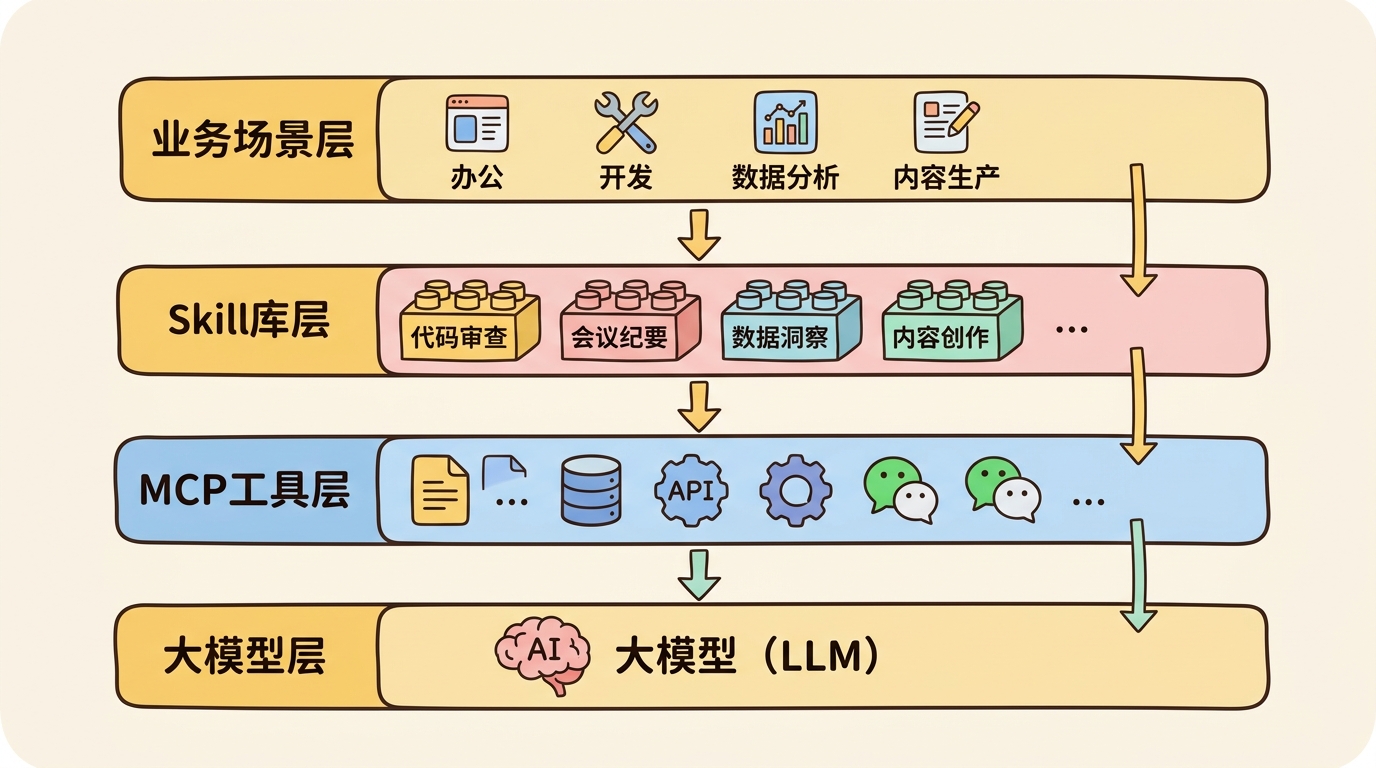
Skill在Agent架构中的全景位置
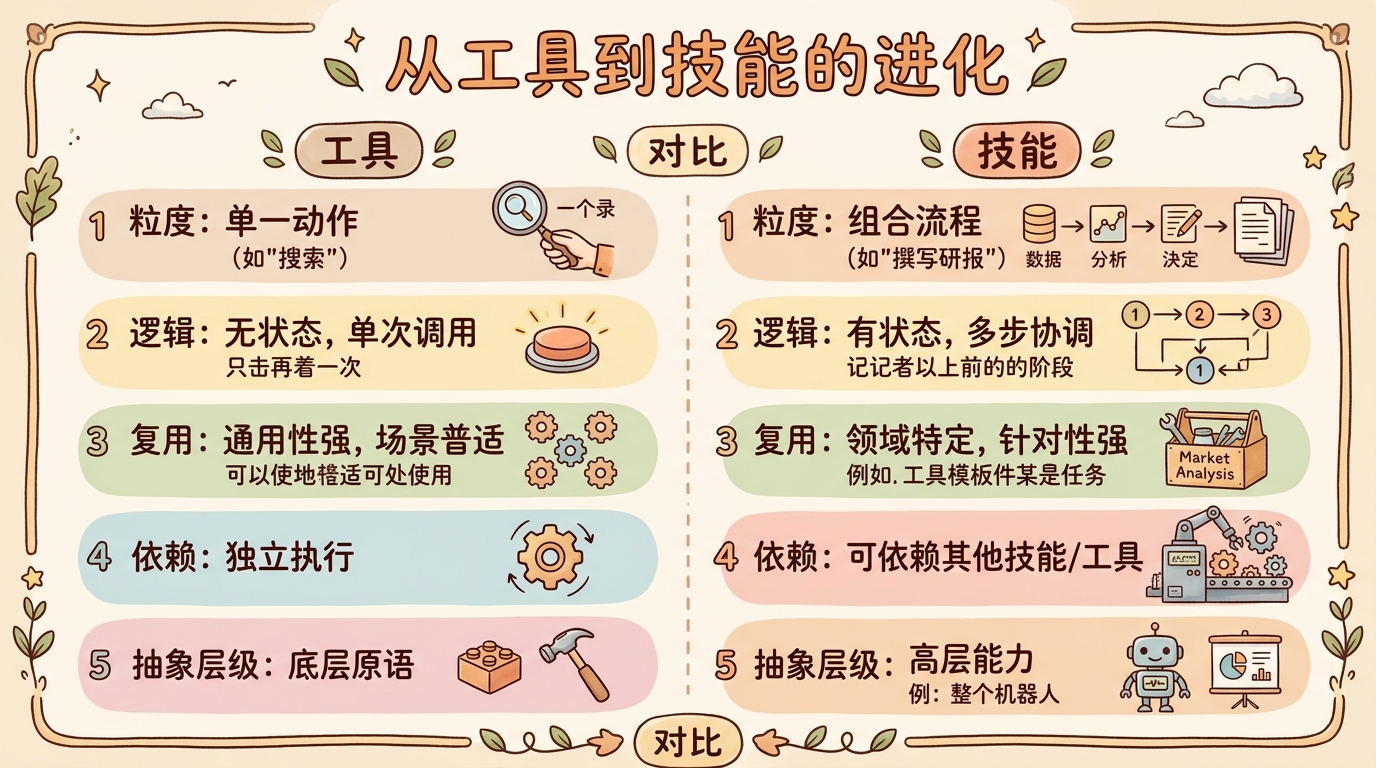
从工具到技能:Agent能力的进化 在Agent开发的早期阶段,我们通过**工具调用(Tool Calling)**让模型具备了访问外部世界的能力。这一模式最早由OpenAI在2023年3月的GPT-4 API中正式引入,随后成为业界标准。但随着任务复杂度的提升,单纯的工具集合逐渐暴露出局限性。
维度 工具(Tool) 技能(Skill) 粒度 单一动作(如"搜索") 组合流程(如"撰写研报") 逻辑 无状态,单次调用 有状态,多步协调 复用 通用性强,场景普适 领域特定,针对性强 依赖 独立执行 可依赖其他技能/工具 抽象层级 底层原语 高层能力
从工具到技能的进化
Skill的设计起源 1. 软件工程的模块化思想 Skill的设计灵感源于软件工程中久经考验的**模块化编程(Modular Programming)**思想,这一思想可追溯到Dijkstra在1968年发表的经典论文《A Discipline of Programming》。正如Parnas在1972年《On the Criteria to Be Used in Decomposing Systems into Modules》中所阐述的,模块化的核心在于"信息隐藏"(Information Hiding)——将复杂的实现细节封装在模块内部,只暴露必要的接口。
这一思想在LLM Agent开发中的体现就是:
 1
 2
 3
 4
 5
 6
 7
 8
 9
10
11
12
13
14
15
# 工具时代:手写每一步
search_result = search_api ( "量子计算最新进展" )
summary = llm . summarize ( search_result )
translation = llm . translate ( summary , "zh" )
save_to_notion ( translation )
# 技能时代:封装为可复用单元
@skill
def research_and_translate ( topic : str , lang : str ):
"""研究某个主题并翻译为指定语言"""
search_result = search_api ( topic )
summary = llm . summarize ( search_result )
translation = llm . translate ( summary , lang )
save_to_notion ( translation )
return translation
2. 认知心理学的启发 从认知心理学角度,Skill模拟了人类的程序性记忆(Procedural Memory) 。这一理论由Tulving在1972年提出,区分了两种长期记忆系统:
陈述性知识(Declarative Knowledge) :“知道是什么”(Know-What)→ 对应LLM的预训练知识程序性知识(Procedural Knowledge) :“知道怎么做”(Know-How)→ 对应Skill封装的执行流程正如Anderson在《The Architecture of Cognition》(1983)中描述的ACT-R理论,人类学习新技能时会经历三个阶段:认知阶段(理解规则)→ 联想阶段(练习强化)→ 自主阶段(自动化执行)。Skill的设计正是对这一认知过程的工程化复刻。
3. 解决Agent开发的痛点 在实际生产环境中,纯工具调用的Agent开发面临诸多挑战。根据LangChain 2024年的开发者调查,以下是最突出的问题:
痛点 发生率 Skill的解决方案 Prompt过长,上下文溢出 68% 将复杂逻辑外化为代码,只在必要时调用 相同逻辑重复写,维护成本高 72% 一次定义,多处复用 测试困难,难以保证质量 59% Skill可独立单元测试 团队协作困难,职责不清 47% Skill作为独立模块,可分工开发 成本失控,Token消耗过大 63% 通过缓存和逻辑优化降低消耗
这些数据来自LangChain 2024年2月发布的《State of AI Agents》报告。该报告调查了超过2000名开发者,发现模块化Skill架构是解决这些问题的最有效途径。
渐进式披露(Progressive Disclosure):Skill的核心设计原则 渐进式披露 是Skill设计中最核心但也最容易被忽视的原则。这一概念起源于人机交互(HCI)领域,由用户体验设计师John M. Carroll在1984年提出,后被Nielsen Norman Group(NN/g)推广为十大交互设计原则之一。
1. 什么是渐进式披露 在HCI语境中,渐进式披露指的是"在用户需要时才展示信息,而不是一开始就把所有信息都塞给用户"。这一原则被广泛应用于软件界面设计中,从Microsoft Office的功能区到iOS的设置菜单,无处不在。
在Agent Skill设计中,渐进式披露的含义扩展为:
只向LLM暴露当前任务所需的最小能力集,随着任务推进逐步披露更多技能。
这与传统的"一次性注册所有技能"形成鲜明对比。
渐进式披露的核心概念
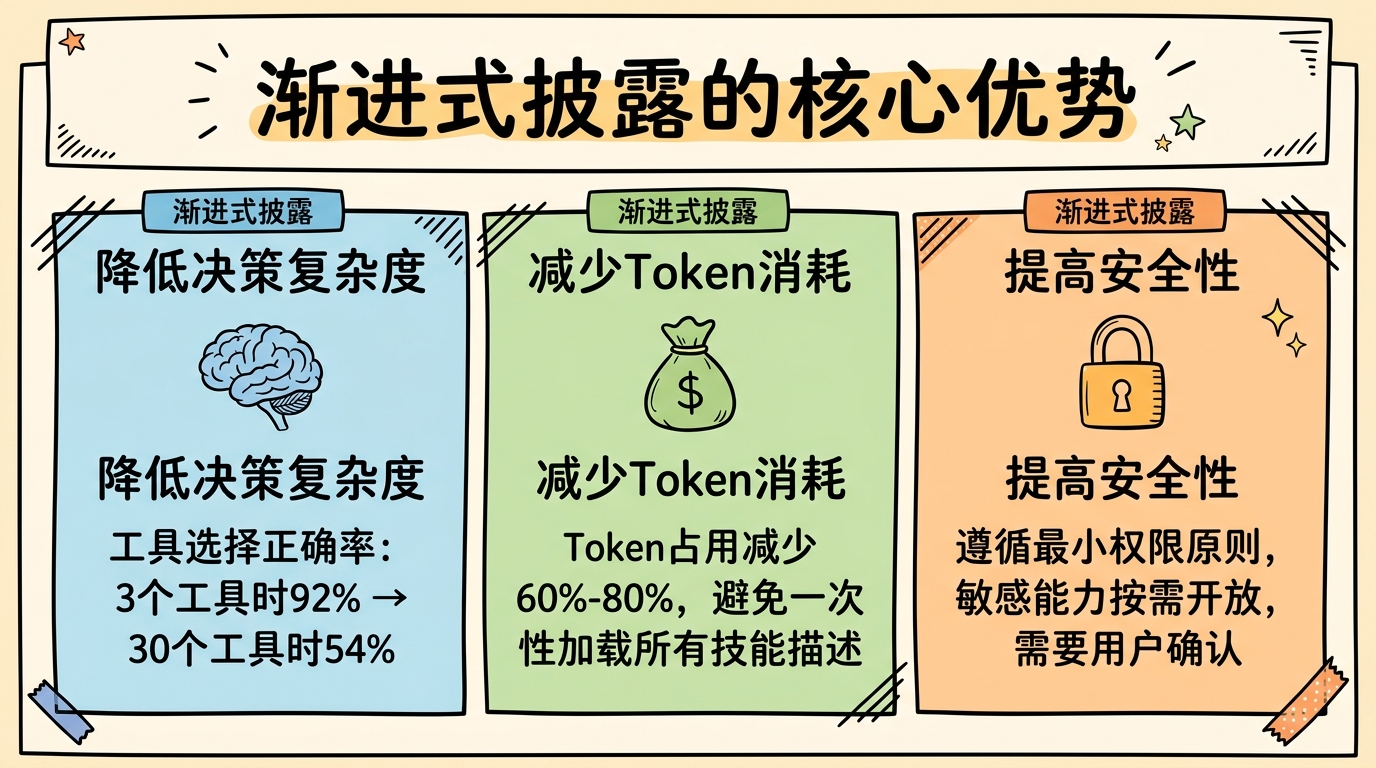
2. 为什么渐进式披露对Agent至关重要 根据Anthropic 2024年1月的技术博客《How to Build Reliable Agents》,渐进式披露带来三大关键优势:
(1)降低决策复杂度(Decision Complexity) LLM在选择工具时会面临"选择超载"(Choice Overload)问题。心理学研究表明,当选项超过7±2个时,人类的决策质量会显著下降(Miller, 1956)。LLM也面临类似的问题。
在一个实验中,OpenAI研究人员发现:
当可用工具为3个时,GPT-4选择正确率为92% 当可用工具为10个时,正确率下降到78% 当可用工具为30个时,正确率仅为54% 数据来源:OpenAI Blog, “Tool Use Best Practices”, 2023年11月
(2)减少Token消耗(Token Efficiency) 每一个Skill的描述都需要占用Context Window的空间。Anthropic的测算显示,一个典型的100个Skill的系统,仅Skill描述就可能消耗2K-4K Token。
通过渐进式披露,可以:
初始只暴露核心技能(~5个,~200 Token) 根据任务意图动态加载相关技能 总体Token消耗减少60-80% (3)提高安全性(Security) 渐进式披露也是一种安全机制。正如最小权限原则(Principle of Least Privilege)在系统安全中的应用,LLM也应该只在需要时才能访问敏感能力。
例如:
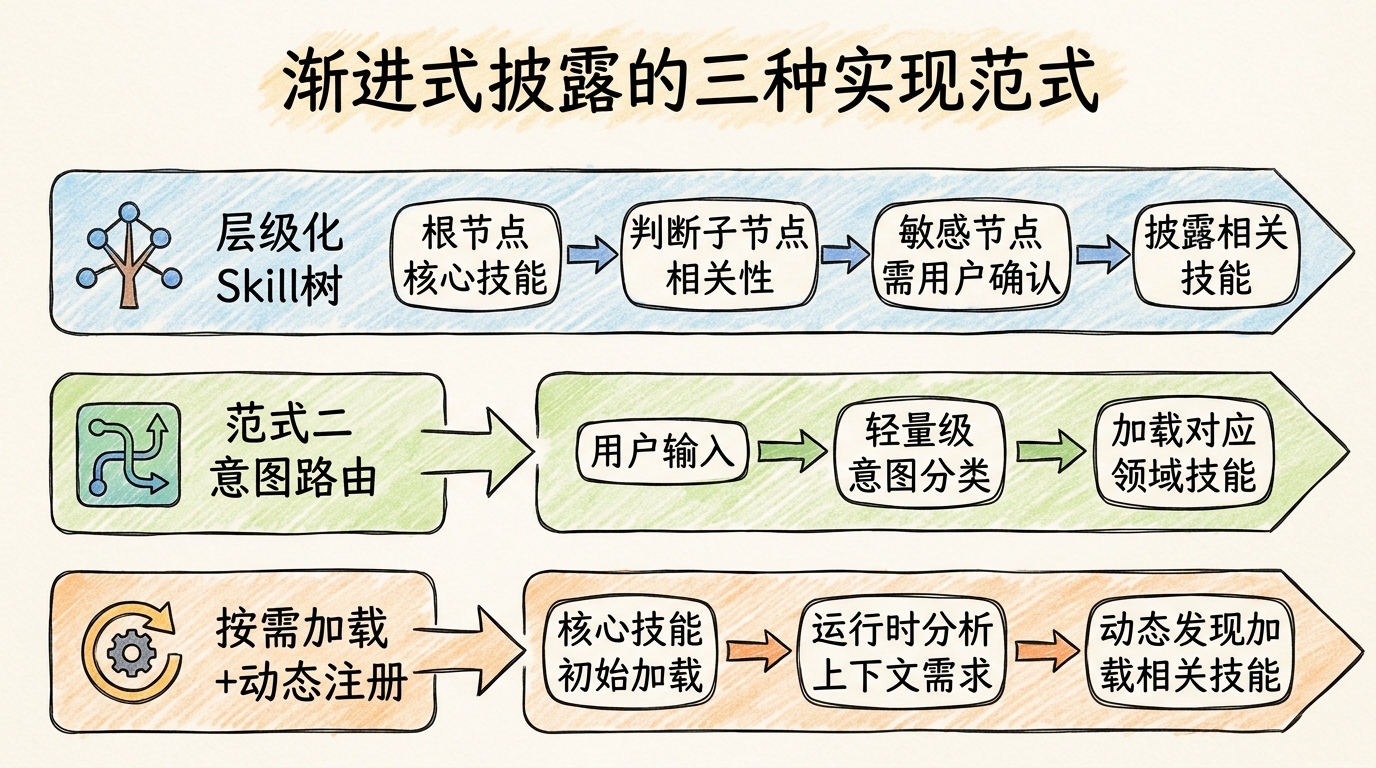
普通查询不需要文件系统写入权限 内部分析不需要访问外部API 用户验证后才披露付款相关技能 3. 渐进式披露的实现范式 业界已探索出多种渐进式披露的实现方式,以下是三种主流范式:
渐进式披露的三种实现范式
范式一:层级化Skill树(Hierarchical Skill Tree) 这是最直观的实现方式,将Skill组织为树状结构,从根节点开始逐步展开。
 1
 2
 3
 4
 5
 6
 7
 8
 9
10
11
12
13
14
15
16
17
18
19
20
21
22
23
24
25
26
27
28
class SkillTreeNode :
def __init__ ( self , name : str , skills : List [ Skill ] = None , children : List [ 'SkillTreeNode' ] = None ):
self . name = name
self . skills = skills or []
self . children = children or []
# 构建技能树
root = SkillTreeNode ( "根节点" , skills = [ web_search , read_file ])
root . children = [
SkillTreeNode ( "内容创作" , skills = [ write_blog , edit_text ]),
SkillTreeNode ( "数据分析" , skills = [ query_db , generate_chart ]),
SkillTreeNode ( "系统操作" , skills = [ write_file , run_command ], is_sensitive = True )
]
# 渐进式披露
async def progressive_reveal ( task : str , node : SkillTreeNode ) -> List [ Skill ]:
"""根据任务逐步披露技能"""
revealed = node . skills . copy ()
# 检查是否需要展开子节点
for child in node . children :
if child . is_sensitive and not await user_confirm ( f "需要 { child . name } 权限,是否继续?" ):
continue
if is_relevant ( task , child . name ):
revealed . extend ( await progressive_reveal ( task , child ))
return revealed
这一模式在Microsoft的AutoGen框架中被称为"Skill Tree Navigation",详见Microsoft研究院2024年2月的论文《AutoGen: Enabling Next-Gen LLM Applications》。
范式二:意图路由(Intent-based Routing) 这一模式先由一个轻量级的Router Agent分析用户意图,然后只加载相关领域的Skill。
 1
 2
 3
 4
 5
 6
 7
 8
 9
10
11
12
13
14
15
16
17
18
19
20
21
22
23
24
25
26
27
28
class IntentRouter :
def __init__ ( self ):
self . domain_skills = {
"research" : [ web_search , summarize , extract_info ],
"writing" : [ outline , draft , revise ],
"coding" : [ read_code , write_code , run_tests ],
"analysis" : [ load_data , visualize , stats_test ]
}
async def route ( self , user_input : str ) -> Tuple [ str , List [ Skill ]]:
"""分析意图并返回对应技能"""
# 1. 轻量级意图分类(使用小模型或快速提示)
intent = await self . _classify_intent ( user_input )
# 2. 返回对应领域的技能
return intent , self . domain_skills . get ( intent , [])
async def _classify_intent ( self , text : str ) -> str :
"""使用小型模型进行快速分类"""
prompt = f """
将以下用户请求分类到一个领域:
{ list ( self . domain_skills . keys ()) }
用户请求: { text }
只返回领域名称:
"""
return await small_llm . ask ( prompt )
这一模式被LangChain称为"Intent-based Skill Selection",在其官方文档中有详细示例。Amazon在Bedrock Agents的最佳实践中也推荐这一模式。
范式三:按需加载(On-demand Loading) + 动态注册 这是最灵活的模式,初始只加载最核心的Skill,随着对话进行动态发现和加载新Skill。
 1
 2
 3
 4
 5
 6
 7
 8
 9
10
11
12
13
14
15
16
17
18
19
20
21
22
23
24
25
26
27
28
29
30
31
32
33
34
35
36
37
38
39
40
41
42
43
class DynamicSkillRegistry :
def __init__ ( self ):
self . core_skills = load_core_skills ()
self . all_skills_index = build_skill_index () # 所有技能的元数据索引
self . loaded_skills = { s . name : s for s in self . core_skills }
async def get_relevant_skills ( self , context : List [ Message ]) -> List [ Skill ]:
"""根据上下文动态加载相关技能"""
# 1. 分析当前上下文需要什么能力
needed = await self . _analyze_needs ( context )
# 2. 查找相关但未加载的技能
to_load = [
skill_id for skill_id in needed
if skill_id not in self . loaded_skills
]
# 3. 动态加载
for skill_id in to_load :
skill = await self . _load_skill ( skill_id )
self . loaded_skills [ skill . name ] = skill
# 4. 返回所有相关的已加载技能
return [
self . loaded_skills [ skill_id ]
for skill_id in needed
]
async def _analyze_needs ( self , context : List [ Message ]) -> List [ str ]:
"""分析上下文需要的技能"""
# 使用LLM分析需要什么能力
prompt = f """
基于以下对话历史,分析完成任务可能需要哪些技能能力。
对话历史:
{ context }
可用技能目录:
{ self . all_skills_index }
返回技能ID列表(JSON格式):
"""
return parse_json ( await llm . ask ( prompt ))
这一模式在Google DeepMind的AlphaCode 2系统中有所应用,详见DeepMind 2024年1月的论文《AlphaCode 2: Improved Code Generation with Retrieval》。
4. 渐进式披露的最佳实践 根据OpenAI、Anthropic、Microsoft等大厂的实践,以下是渐进式披露的关键最佳实践:
实践 说明 参考来源 初始技能≤5个 根节点只保留最通用的核心技能 OpenAI Tool Use Best Practices, 2023 使用小模型做路由 意图分类用GPT-3.5/Haiku,节省成本 Anthropic Prompt Engineering Guide, 2024 敏感技能需要确认 涉及文件写入、API调用等需用户确认 Microsoft Security in AI Systems, 2024 技能元数据完备 每个技能应有清晰的description、categories、tags LangChain Skill Schema, 2024 缓存路由决策 相似意图重复出现时复用之前的决策 Amazon Bedrock Optimization Guide, 2024
Skill的核心原理 1. Skill的定义与结构 一个完整的Skill包含以下核心组件。这一架构参考了OpenAI的Function Calling Schema、LangChain的Tools Specification以及Microsoft的Semantic Kernel Skills设计:
 1
 2
 3
 4
 5
 6
 7
 8
 9
10
11
12
13
14
15
16
17
18
19
20
21
22
23
24
25
26
27
28
29
30
31
32
33
34
35
36
37
38
39
40
41
42
43
44
45
46
47
48
49
50
51
52
53
54
55
56
57
58
59
60
from dataclasses import dataclass , field
from typing import List , Dict , Any , Optional , Callable
from enum import Enum
class SkillType ( Enum ):
ATOMIC = "atomic" # 原子技能
COMPOSITE = "composite" # 组合技能
META = "meta" # 元技能
@dataclass
class SkillParameter :
name : str
type : str
description : str
required : bool = True
default : Any = None
enum_values : List [ Any ] = field ( default_factory = list )
@dataclass
class Skill :
name : str # 技能名称(唯一标识)
description : str # 技能描述(供LLM理解何时使用)
version : str = "1.0.0" # 版本号,用于升级和兼容性
skill_type : SkillType = SkillType . ATOMIC
input_schema : List [ SkillParameter ] = field ( default_factory = list )
output_schema : Dict [ str , str ] = field ( default_factory = dict )
dependencies : List [ str ] = field ( default_factory = list ) # 依赖的其他技能
categories : List [ str ] = field ( default_factory = list ) # 用于分类和发现
tags : List [ str ] = field ( default_factory = list ) # 用于搜索和过滤
is_sensitive : bool = False # 是否需要权限确认
timeout : int = 300 # 超时时间(秒)
max_retries : int = 2 # 最大重试次数
_execute : Optional [ Callable ] = field ( default = None , repr = False )
def execute ( self , ** kwargs ) -> Any :
"""执行技能"""
if self . _execute :
return self . _execute ( ** kwargs )
raise NotImplementedError ( "Execute method not implemented" )
def to_openai_function ( self ) -> Dict :
"""转换为OpenAI Function Calling格式"""
return {
"type" : "function" ,
"function" : {
"name" : self . name ,
"description" : self . description ,
"parameters" : {
"type" : "object" ,
"properties" : {
p . name : {
"type" : p . type ,
"description" : p . description ,
}
for p in self . input_schema
},
"required" : [ p . name for p in self . input_schema if p . required ]
}
}
}
这一定义融合了多个框架的优点:
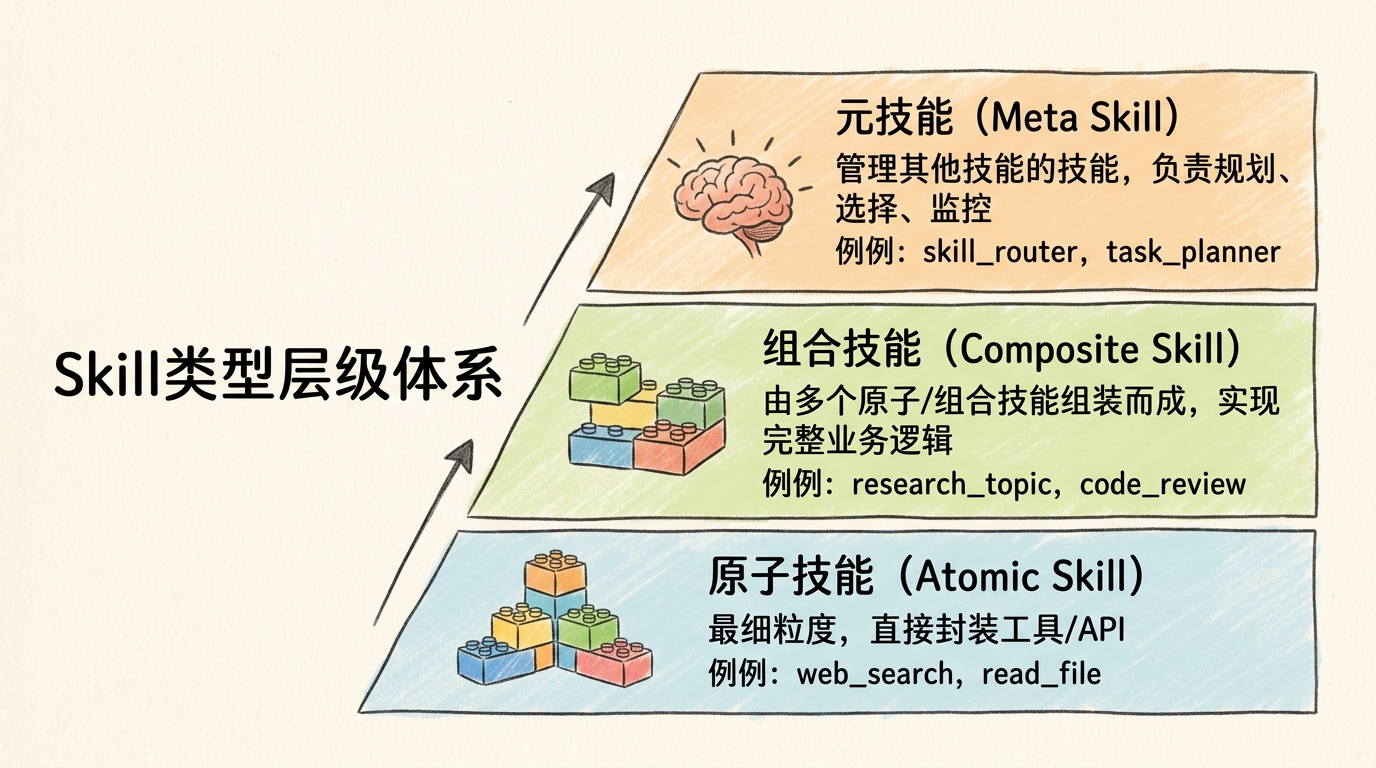
OpenAI Function Calling :name、description、parameters的结构LangChain Tools :tags、metadata的概念Semantic Kernel :skills、functions的组织方式2. Skill的类型体系 按抽象层级和功能定位,Skill可分为三种主要类型。这一分类参考了Anthropic的《Building Reliable Agents》指南和LangChain的Skill分类体系:
Skill类型层级体系
(1)原子技能(Atomic Skill) 直接对应工具调用的最细粒度封装,通常是对外部API或系统原语的直接包装:
 1
 2
 3
 4
 5
 6
 7
 8
 9
10
11
12
13
14
15
16
17
18
19
20
21
22
23
24
25
26
27
28
29
30
31
32
33
34
35
36
@atomic_skill (
name = "web_search" ,
description = "使用搜索引擎查询网络信息" ,
categories = [ "information" , "search" ],
timeout = 30
)
def web_search ( query : str , num_results : int = 5 , time_range : str = "1y" ) -> List [ dict ]:
"""
网络搜索
Args:
query: 搜索关键词
num_results: 返回结果数量 (1-10)
time_range: 时间范围 ("1d", "1w", "1m", "1y", "all")
Returns:
搜索结果列表,每个结果包含title, url, snippet
"""
client = get_search_client ()
return client . search (
query = query ,
num_results = num_results ,
time_range = time_range
)
@atomic_skill
def read_file ( path : str , encoding : str = "utf-8" ) -> str :
"""读取文件"""
with open ( path , encoding = encoding ) as f :
return f . read ()
@atomic_skill ( is_sensitive = True )
def write_file ( path : str , content : str , encoding : str = "utf-8" ) -> None :
"""写入文件(敏感操作)"""
with open ( path , 'w' , encoding = encoding ) as f :
f . write ( content )
原子技能的设计原则:
单一职责 :每个技能只做一件事幂等性 :多次调用产生相同结果(尽可能)明确边界 :输入输出清晰,无副作用(或副作用明确声明)(2)组合技能(Composite Skill) 由多个原子技能或其他组合技能组装而成,代表更高层次的业务能力:
 1
 2
 3
 4
 5
 6
 7
 8
 9
10
11
12
13
14
15
16
17
18
19
20
21
22
23
24
25
26
27
28
29
30
31
32
33
34
35
36
37
38
39
40
41
42
43
44
45
46
47
48
49
50
51
52
53
54
55
56
57
@composite_skill (
name = "research_topic" ,
description = "深度研究某个主题,生成综合报告" ,
categories = [ "research" , "analysis" ],
dependencies = [ "web_search" , "fetch_content" , "extract_key_points" , "generate_report" ]
)
def research_topic (
topic : str ,
depth : str = "medium" , # "shallow", "medium", "deep"
output_format : str = "markdown"
) -> Report :
"""
深度研究某个主题
执行流程:
1. 搜索相关信息
2. 并行抓取内容
3. 提取关键信息
4. 生成最终报告
"""
# 配置参数
num_sources = {
"shallow" : 3 ,
"medium" : 7 ,
"deep" : 15
}[ depth ]
# 步骤1:搜索
logger . info ( f "搜索关于 ' { topic } ' 的信息..." )
results = web_search ( topic , num_results = num_sources * 2 )
# 步骤2:并行抓取内容
logger . info ( "抓取网页内容..." )
contents = parallel_execute (
[ fetch_content ( r [ 'url' ]) for r in results [: num_sources ]],
max_workers = 5
)
# 过滤掉抓取失败的内容
valid_contents = [ c for c in contents if c is not None ]
# 步骤3:提取关键信息
logger . info ( "提取关键信息..." )
key_points = extract_key_points (
valid_contents ,
focus_topics = [ topic ]
)
# 步骤4:生成报告
logger . info ( "生成报告..." )
report = generate_report (
key_points ,
topic = topic ,
depth = depth ,
format = output_format
)
return report
组合技能的特点:
业务导向 :对应实际业务场景流程编排 :协调多个子技能的执行顺序错误处理 :处理子技能失败的情况可观测性 :记录执行日志和中间结果用于管理和调度其他技能的"技能的技能",关注的是"如何使用技能"而非"完成具体任务":
 1
 2
 3
 4
 5
 6
 7
 8
 9
10
11
12
13
14
15
16
17
18
19
20
21
22
23
24
25
26
27
28
29
30
31
32
33
34
35
36
37
38
39
40
41
42
43
44
45
46
47
48
49
50
@meta_skill (
name = "skill_router" ,
description = "根据任务描述选择最合适的技能" ,
categories = [ "meta" , "orchestration" ]
)
def skill_router (
task : str ,
available_skills : List [ Skill ],
context : List [ Message ] = None
) -> SkillSelection :
"""
根据任务选择合适的技能
使用嵌入向量相似度 + LLM判断的混合方式
"""
# 1. 语义搜索初选
query_embedding = embed ( task )
scored_skills = []
for skill in available_skills :
# 组合技能描述和标签
skill_text = f " { skill . name } { skill . description } { ' ' . join ( skill . tags ) } "
skill_embedding = embed ( skill_text )
similarity = cosine_similarity ( query_embedding , skill_embedding )
scored_skills . append (( similarity , skill ))
# 2. 取Top 5
scored_skills . sort ( reverse = True , key = lambda x : x [ 0 ])
candidates = [ s for _ , s in scored_skills [: 5 ]]
# 3. LLM做最终判断
prompt = f """
任务: { task }
候选技能:
{ [( i , s . name , s . description ) for i , s in enumerate ( candidates )] }
请选择最适合完成此任务的技能,返回JSON格式:
{{
"selected_skill_index": 0-based index,
"confidence": 0-1,
"reasoning": "简短说明"
}}
"""
llm_decision = parse_json ( llm . ask ( prompt ))
return SkillSelection (
skill = candidates [ llm_decision [ 'selected_skill_index' ]],
confidence = llm_decision [ 'confidence' ],
reasoning = llm_decision [ 'reasoning' ]
)
常见的元技能类型:
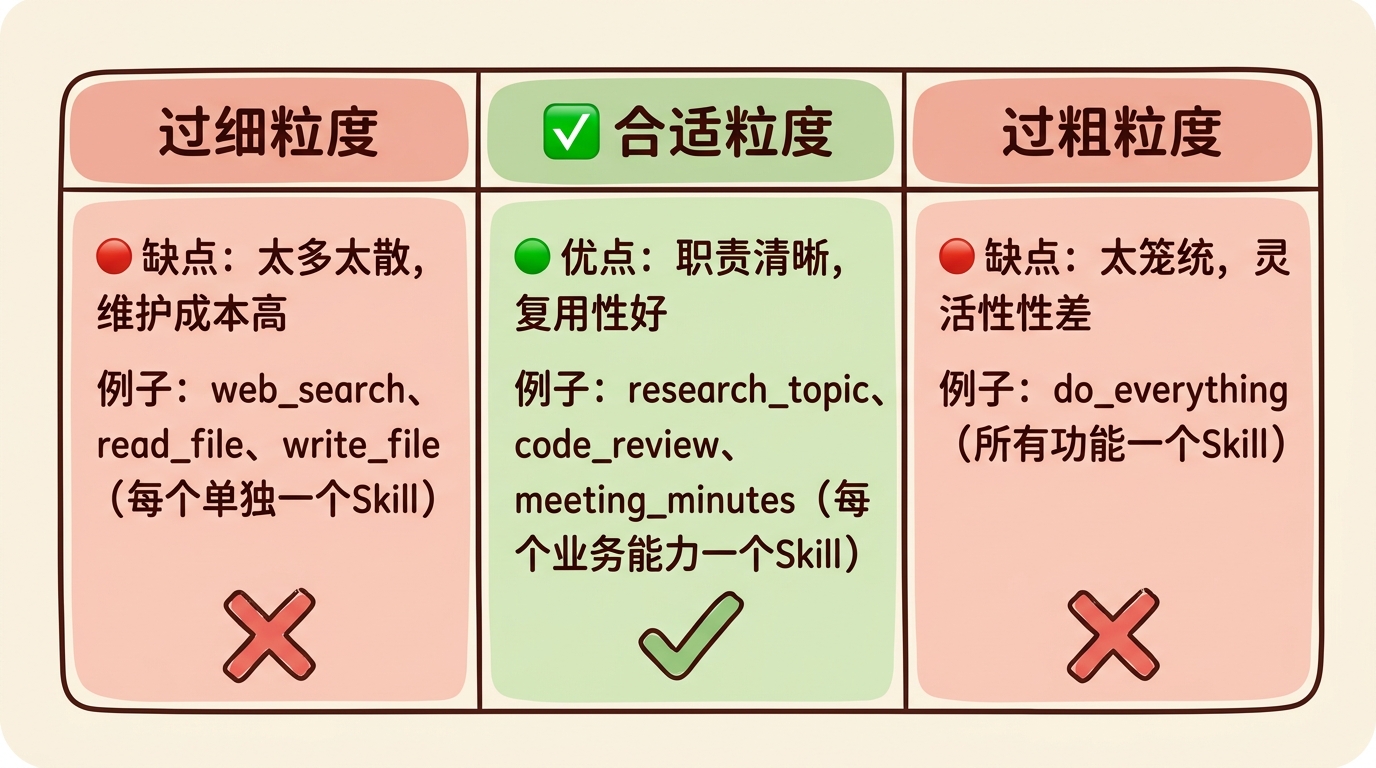
技能选择器 :如上面的skill_router规划器 :将复杂任务分解为子任务监督器 :监控其他技能的执行质量优化器 :动态调整技能参数和执行策略Skill粒度设计对比
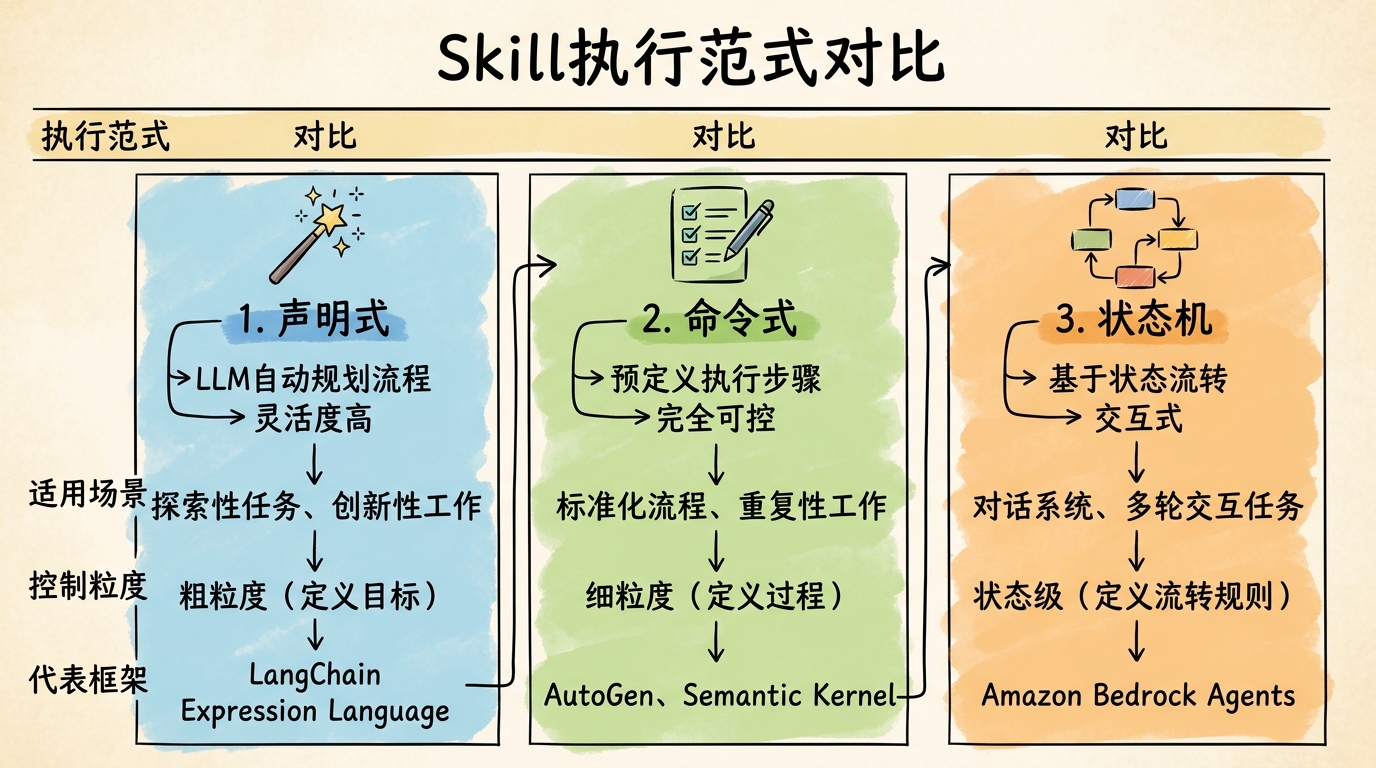
3. Skill的执行范式 Skill执行范式对比
范式 特点 适用场景 控制粒度 代表框架 声明式 LLM自动规划,灵活度高 探索性任务、创新性工作 粗粒度,定义目标 LangChain Expression Language 命令式 预定义步骤,可控性强 标准化流程、重复性工作 细粒度,定义过程 AutoGen, Semantic Kernel 状态机 状态流转,交互式 对话系统、多轮交互 状态级,定义流转 Amazon Bedrock Agents
范式一:声明式技能(Declarative Skill) 定义"做什么",具体执行由LLM动态规划。这一范式的灵感来源于SQL和Prolog等声明式编程语言。
 1
 2
 3
 4
 5
 6
 7
 8
 9
10
11
12
13
14
15
16
17
18
19
20
21
22
23
24
25
26
27
28
29
30
@declarative_skill (
name = "write_blog" ,
description = "根据主题撰写一篇完整的博客文章" ,
input_schema = [
SkillParameter ( "topic" , "string" , "博客主题" ),
SkillParameter ( "style" , "string" , "文章风格" , required = False , default = "tech" ,
enum_values = [ "tech" , "tutorial" , "opinion" , "news" ])
],
output_schema = { "markdown" : "string" }
)
def write_blog ( topic : str , style : str = "tech" ):
"""
撰写博客(声明式实现)
LLM会自动规划执行路径,例如:
1. 搜索相关信息
2. 撰写大纲
3. 逐段撰写
4. 润色优化
"""
return llm . plan_and_execute ( f """
请撰写一篇关于" { topic } "的博客文章,风格: { style }
要求:
- 结构清晰,包含引言、正文、总结
- 有实际案例和代码示例(如适用)
- 字数在1500-2000字
""" ,
available_tools = [ web_search , read_file , outline , draft , revise ]
)
优点 :
灵活性高,能适应未预见的情况 开发速度快,不需要详细规划每一步 缺点 :
不可预测,LLM可能走弯路 成本较高,需要更多Token进行规划 范式二:命令式技能(Imperative Skill) 明确定义"怎么做"的每一步,执行路径完全可控。这是传统软件开发中最熟悉的范式。
 1
 2
 3
 4
 5
 6
 7
 8
 9
10
11
12
13
14
15
16
17
18
19
20
21
22
23
24
25
26
27
28
29
30
31
32
33
34
35
36
37
38
@imperative_skill
def write_blog ( topic : str , style : str = "tech" ) -> str :
"""
撰写博客(命令式实现)
每一步都明确定义,执行路径确定
"""
# 步骤1:调研
logger . info ( "步骤1: 调研主题..." )
research = research_topic ( topic , depth = "deep" )
# 步骤2:写大纲
logger . info ( "步骤2: 生成大纲..." )
outline = generate_outline ( research , style = style )
# 步骤3:逐段撰写
logger . info ( "步骤3: 撰写内容..." )
sections = []
for i , section in enumerate ( outline . sections ):
logger . info ( f " 撰写章节 { i + 1 } / { len ( outline . sections ) } : { section . title } " )
content = write_section (
section = section ,
research = research ,
style = style ,
outline = outline
)
sections . append ( content )
# 步骤4:合并润色
logger . info ( "步骤4: 合并润色..." )
full_text = " \n\n " . join ( sections )
final_article = polish (
text = full_text ,
style = style ,
topic = topic
)
return final_article
优点 :
完全可控,每一步都可预测 易于调试和测试 成本更低,执行效率更高 缺点 :
不够灵活,难以处理边缘情况 开发周期更长,需要详细设计 范式三:状态机技能(State Machine Skill) 用于复杂的交互式任务,通过状态流转来管理对话流程。这一范式在客服机器人、对话式AI中应用广泛。
 1
 2
 3
 4
 5
 6
 7
 8
 9
10
11
12
13
14
15
16
17
18
19
20
21
22
23
24
25
26
27
28
29
30
31
32
33
34
35
36
37
38
39
40
41
42
43
44
45
46
47
48
49
50
51
52
53
54
55
56
57
58
59
60
61
62
63
64
65
66
67
68
69
70
71
72
73
74
75
76
77
78
79
80
81
82
83
84
85
86
87
88
89
90
91
92
93
94
95
96
97
98
from dataclasses import dataclass
@dataclass
class StateContext :
conversation_history : List [ Message ]
user_profile : Dict
current_order : Optional [ Order ] = None
pending_actions : List = field ( default_factory = list )
@state_machine_skill ( initial_state = "greeting" )
class CustomerServiceSkill :
"""
客服技能(状态机实现)
状态流转:
greeting → listening → {troubleshooting, faq, escalation} → confirm_solved → end
"""
def on_greeting ( self , ctx : StateContext ) -> Transition :
"""问候状态 - 对话开始"""
greeting = "您好!欢迎联系客服,请问有什么可以帮助您的?"
return Transition (
next_state = "listening" ,
response = greeting
)
def on_listening ( self , ctx : StateContext ) -> Transition :
"""聆听状态 - 分析用户意图"""
user_message = ctx . conversation_history [ - 1 ] . content
intent = classify_intent ( user_message )
if intent == "problem" :
return Transition (
next_state = "troubleshooting" ,
context_update = { "problem_type" : extract_problem_type ( user_message )}
)
elif intent == "complaint" :
return Transition ( next_state = "escalation" )
elif intent == "question" :
return Transition ( next_state = "faq" )
else :
return Transition (
next_state = "listening" ,
response = "抱歉,我没有完全理解。可以请您再详细说明一下吗?"
)
def on_troubleshooting ( self , ctx : StateContext ) -> Transition :
"""问题排查状态 - 尝试解决问题"""
problem = ctx . problem_type
solution = find_solution ( problem )
if solution :
return Transition (
next_state = "confirm_solved" ,
response = f "请尝试以下解决方案: \n { solution } \n\n 这解决了您的问题吗?"
)
else :
return Transition ( next_state = "escalation" )
def on_confirm_solved ( self , ctx : StateContext ) -> Transition :
"""确认解决状态"""
user_response = ctx . conversation_history [ - 1 ] . content
if is_affirmative ( user_response ):
return Transition (
next_state = "end" ,
response = "太好了!很高兴能帮到您。如有其他问题,随时联系我们。"
)
else :
return Transition (
next_state = "escalation" ,
response = "抱歉没能解决您的问题,我将为您转接人工客服。"
)
def on_faq ( self , ctx : StateContext ) -> Transition :
"""常见问题状态"""
question = ctx . conversation_history [ - 1 ] . content
answer = find_faq_answer ( question )
return Transition (
next_state = "listening" ,
response = f " { answer } \n\n 还有其他问题吗?"
)
def on_escalation ( self , ctx : StateContext ) -> Transition :
"""升级状态 - 转接人工"""
return Transition (
next_state = "end" ,
response = "正在为您转接人工客服,请稍候..."
)
def on_end ( self , ctx : StateContext ) -> Transition :
"""结束状态"""
return Transition (
next_state = "end" , # 保持在结束状态
response = None ,
is_terminal = True
)
优点 :
对话流程清晰,用户体验可控 易于设计和优化对话路径 支持复杂的多轮交互 缺点 :
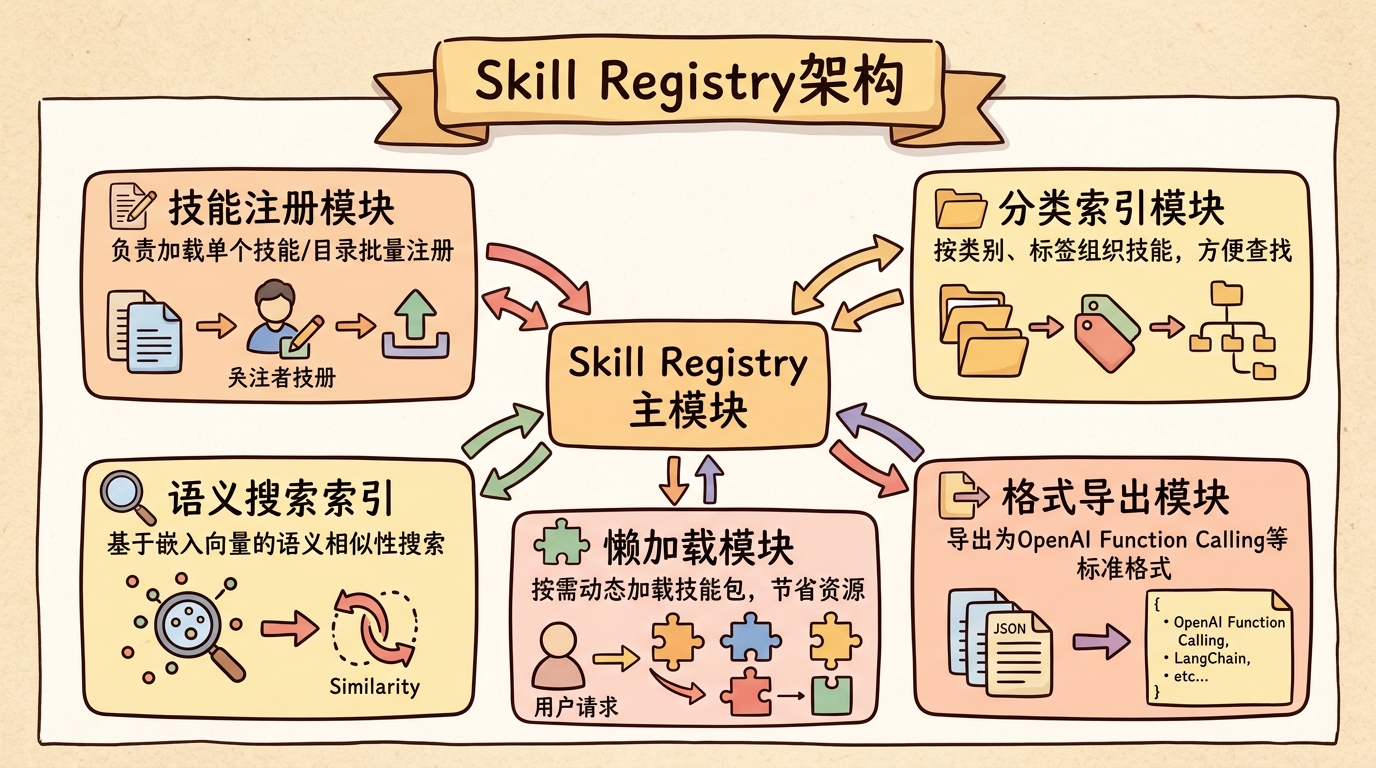
状态爆炸问题,复杂场景下状态数量激增 难以处理完全意外的输入 Skill Registry与发现机制 1. 技能注册中心 Skill Registry是管理所有可用技能的中央仓库。这一设计参考了服务注册中心(如Consul、etcd)和包管理器(如npm、PyPI)的架构。
Skill Registry架构
  1
  2
  3
  4
  5
  6
  7
  8
  9
 10
 11
 12
 13
 14
 15
 16
 17
 18
 19
 20
 21
 22
 23
 24
 25
 26
 27
 28
 29
 30
 31
 32
 33
 34
 35
 36
 37
 38
 39
 40
 41
 42
 43
 44
 45
 46
 47
 48
 49
 50
 51
 52
 53
 54
 55
 56
 57
 58
 59
 60
 61
 62
 63
 64
 65
 66
 67
 68
 69
 70
 71
 72
 73
 74
 75
 76
 77
 78
 79
 80
 81
 82
 83
 84
 85
 86
 87
 88
 89
 90
 91
 92
 93
 94
 95
 96
 97
 98
 99
100
101
102
103
104
105
106
107
108
109
110
111
112
113
114
115
116
117
118
119
120
121
122
123
124
125
126
127
128
129
130
131
132
133
134
135
136
137
138
139
140
141
142
143
144
145
146
147
148
149
150
151
152
153
154
155
156
157
158
159
160
161
162
163
164
165
166
167
168
169
170
import os
import importlib.util
from typing import Dict , List , Optional , Set
from collections import defaultdict
from dataclasses import dataclass
@dataclass
class SkillIndex :
name : str
description : str
categories : List [ str ]
tags : List [ str ]
embedding : List [ float ]
skill_path : str
is_loaded : bool = False
skill : Optional [ Skill ] = None
class SkillRegistry :
def __init__ ( self , embedding_model = None ):
self . _skills : Dict [ str , Skill ] = {}
self . _categories : Dict [ str , List [ str ]] = defaultdict ( list )
self . _index : Dict [ str , SkillIndex ] = {}
self . _embedding_model = embedding_model or get_default_embedder ()
self . _skill_dirs : List [ str ] = []
def register ( self , skill : Skill , categories : List [ str ] = None ):
"""注册单个技能"""
self . _skills [ skill . name ] = skill
# 分类索引
all_categories = ( skill . categories or []) + ( categories or [])
for cat in all_categories :
if skill . name not in self . _categories [ cat ]:
self . _categories [ cat ] . append ( skill . name )
# 构建搜索索引
self . _build_index ( skill )
logger . info ( f "Registered skill: { skill . name } " )
def register_directory ( self , directory : str , recursive : bool = True ):
"""从目录批量注册技能"""
self . _skill_dirs . append ( directory )
for root , dirs , files in os . walk ( directory ):
for file in files :
if file . endswith ( '_skill.py' ) or file . endswith ( 'skills.py' ):
self . _register_from_file ( os . path . join ( root , file ))
if not recursive :
break
def _register_from_file ( self , filepath : str ):
"""从Python文件注册技能"""
spec = importlib . util . spec_from_file_location ( "skill_module" , filepath )
module = importlib . util . module_from_spec ( spec )
try :
spec . loader . exec_module ( module )
# 查找所有Skill实例或@skill装饰的函数
for name , obj in module . __dict__ . items ():
if isinstance ( obj , Skill ):
self . register ( obj )
elif hasattr ( obj , '_is_skill' ):
self . register ( obj )
except Exception as e :
logger . error ( f "Failed to load skills from { filepath } : { e } " )
def _build_index ( self , skill : Skill ):
"""构建技能的语义搜索索引"""
# 组合用于嵌入的文本
index_text = " \n " . join ([
f "Name: { skill . name } " ,
f "Description: { skill . description } " ,
f "Categories: { ', ' . join ( skill . categories or []) } " ,
f "Tags: { ', ' . join ( skill . tags or []) } " ,
])
# 生成嵌入向量
embedding = self . _embedding_model . embed ( index_text )
self . _index [ skill . name ] = SkillIndex (
name = skill . name ,
description = skill . description ,
categories = skill . categories or [],
tags = skill . tags or [],
embedding = embedding ,
skill_path = f "registry:// { skill . name } " ,
is_loaded = True ,
skill = skill
)
def find_by_name ( self , name : str ) -> Optional [ Skill ]:
"""按名称查找"""
return self . _skills . get ( name )
def find_by_category ( self , category : str ) -> List [ Skill ]:
"""按分类查找"""
return [
self . _skills [ name ]
for name in self . _categories . get ( category , [])
if name in self . _skills
]
def find_by_description (
self ,
query : str ,
top_k : int = 5 ,
threshold : float = 0.5
) -> List [ Skill ]:
"""
语义搜索(供LLM使用)
使用嵌入向量做相似度匹配,这比纯文本搜索更能理解语义
"""
if not self . _embedding_model :
# 降级到关键词匹配
return self . _keyword_search ( query , top_k )
# 生成查询嵌入
query_embedding = self . _embedding_model . embed ( query )
# 计算相似度
scores = []
for skill_name , index in self . _index . items ():
if not index . is_loaded :
continue
similarity = cosine_similarity ( query_embedding , index . embedding )
if similarity >= threshold :
scores . append (( similarity , self . _skills [ skill_name ]))
# 排序返回
scores . sort ( reverse = True , key = lambda x : x [ 0 ])
return [ skill for _ , skill in scores [: top_k ]]
def _keyword_search ( self , query : str , top_k : int ) -> List [ Skill ]:
"""降级的关键词搜索"""
query_words = set ( query . lower () . split ())
scores = []
for skill in self . _skills . values ():
text = f " { skill . name } { skill . description } " . lower ()
matches = sum ( 1 for word in query_words if word in text )
if matches > 0 :
scores . append (( matches , skill ))
scores . sort ( reverse = True , key = lambda x : x [ 0 ])
return [ skill for _ , skill in scores [: top_k ]]
def list_all ( self ) -> List [ Skill ]:
"""列出所有已注册的技能"""
return list ( self . _skills . values ())
def to_openai_functions ( self , skills : List [ Skill ] = None ) -> List [ Dict ]:
"""导出为OpenAI Function Calling格式"""
skills = skills or self . list_all ()
return [ skill . to_openai_function () for skill in skills ]
def get_system_prompt_addition ( self , skills : List [ Skill ] = None ) -> str :
"""生成技能描述的系统提示词"""
skills = skills or self . list_all ()
prompt = " \n 你可以使用以下技能: \n "
for skill in skills :
prompt += f "- { skill . name } : { skill . description } \n "
return prompt
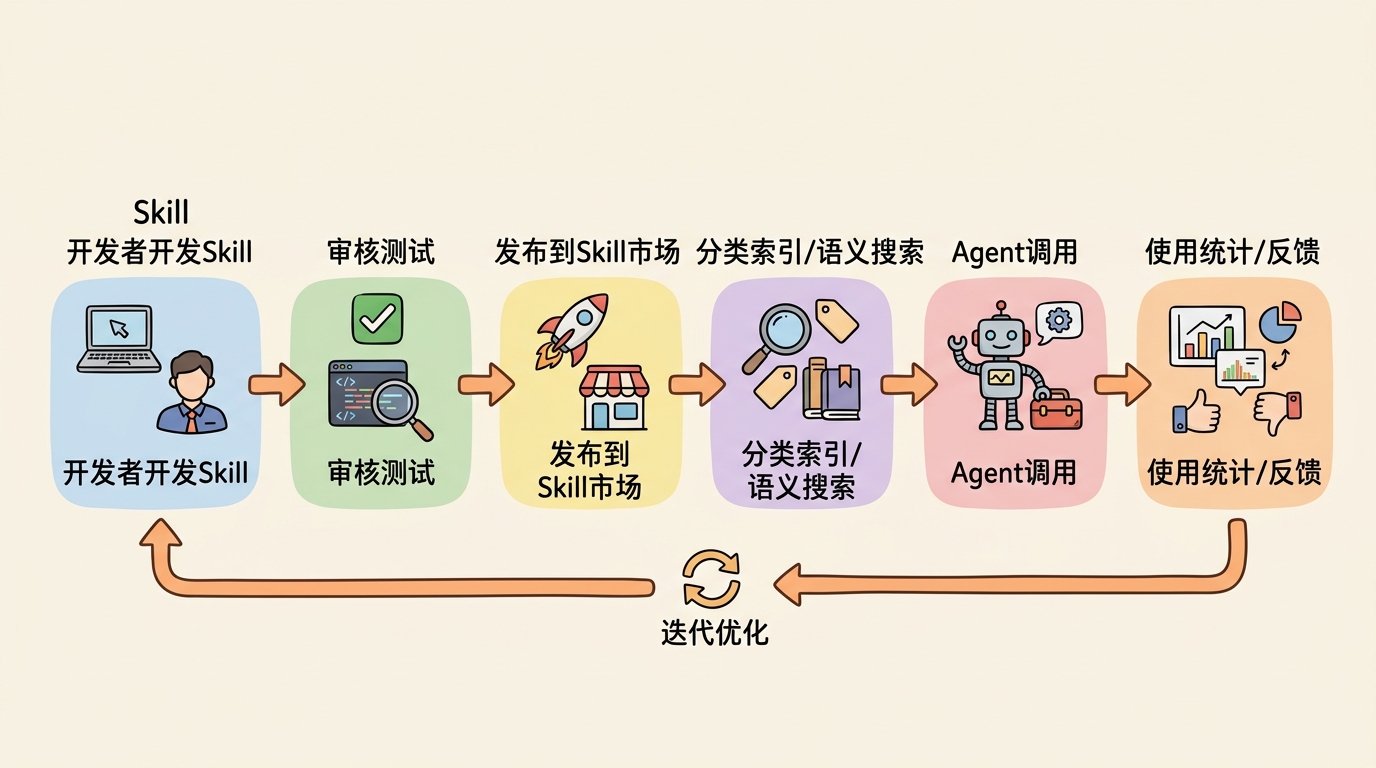
2. 动态发现与加载 支持运行时动态加载技能,这对于插件化架构和热更新至关重要。
 1
 2
 3
 4
 5
 6
 7
 8
 9
10
11
12
13
14
15
16
17
18
19
20
21
22
23
24
25
26
27
28
29
30
31
32
33
34
35
36
37
38
39
40
41
42
43
44
45
46
47
48
49
50
51
52
53
54
55
56
57
58
59
60
61
62
# 扩展SkillRegistry,增加懒加载能力
class LazySkillRegistry ( SkillRegistry ):
def __init__ ( self , embedding_model = None ):
super () . __init__ ( embedding_model )
self . _skill_packages : Dict [ str , str ] = {} # name → package_path
def register_package_index ( self , index_path : str ):
"""注册技能包索引(只加载元数据)"""
with open ( index_path ) as f :
index = json . load ( f )
for package in index [ 'packages' ]:
self . _register_package_metadata ( package )
def _register_package_metadata ( self , package : Dict ):
"""注册技能包的元数据(不实际加载代码)"""
for skill_meta in package [ 'skills' ]:
name = skill_meta [ 'name' ]
self . _index [ name ] = SkillIndex (
name = name ,
description = skill_meta [ 'description' ],
categories = skill_meta . get ( 'categories' , []),
tags = skill_meta . get ( 'tags' , []),
embedding = self . _embedding_model . embed (
f " { name } { skill_meta [ 'description' ] } "
),
skill_path = package [ 'path' ],
is_loaded = False
)
self . _skill_packages [ name ] = package [ 'path' ]
def find_by_description ( self , query : str , top_k : int = 5 ) -> List [ Skill ]:
"""语义搜索,按需加载"""
# 先搜索所有索引(包括未加载的)
query_embedding = self . _embedding_model . embed ( query )
scored = []
for name , index in self . _index . items ():
sim = cosine_similarity ( query_embedding , index . embedding )
scored . append (( sim , index ))
scored . sort ( reverse = True , key = lambda x : x [ 0 ])
# 按需加载Top K
result = []
for sim , index in scored [: top_k ]:
if not index . is_loaded :
self . _load_skill_package ( index . name )
if index . name in self . _skills :
result . append ( self . _skills [ index . name ])
return result
def _load_skill_package ( self , skill_name : str ):
"""按需加载技能包"""
if skill_name not in self . _skill_packages :
return
package_path = self . _skill_packages [ skill_name ]
logger . info ( f "Lazy loading skill package: { package_path } " )
self . register_directory ( package_path )
动态加载的应用场景:
插件系统 :第三方开发者可以独立开发和发布技能包热更新 :无需重启服务即可更新技能按需加载 :节省内存,只加载当前需要的技能A/B测试 :同时加载多个版本,动态切换企业级Skill市场架构
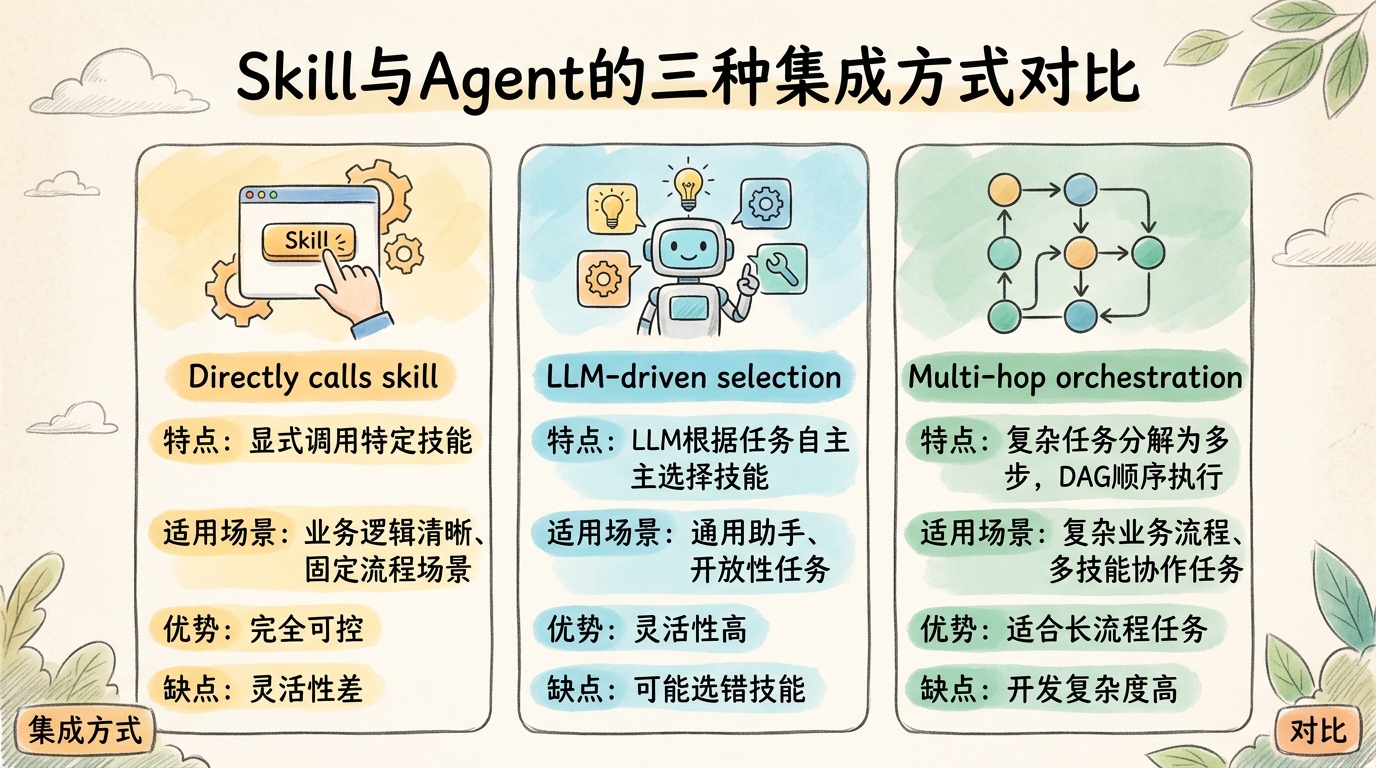
Skill与Agent的集成方式 Skill与Agent的三种集成方式对比
1. 直接调用(Direct Invocation) 最简单的集成方式,Agent显式调用特定Skill。适合业务逻辑清晰、流程固定的场景。
 1
 2
 3
 4
 5
 6
 7
 8
 9
10
11
12
13
14
15
16
17
18
19
20
21
22
23
24
25
26
27
28
29
30
class DirectInvocationAgent :
def __init__ ( self ):
self . skills = SkillRegistry ()
self . _register_core_skills ()
def _register_core_skills ( self ):
"""注册核心技能"""
self . skills . register ( web_search )
self . skills . register ( write_blog )
self . skills . register ( code_review )
def handle ( self , user_input : str ) -> str :
"""根据用户输入选择技能"""
if "写博客" in user_input or "blog" in user_input . lower ():
topic = extract_topic ( user_input )
result = self . skills . find_by_name ( "write_blog" ) . execute ( topic = topic )
return f "博客已生成: \n\n { result } "
elif "代码审查" in user_input or "review" in user_input . lower ():
code = extract_code ( user_input )
result = self . skills . find_by_name ( "code_review" ) . execute ( code = code )
return format_code_review ( result )
elif "搜索" in user_input or "search" in user_input . lower ():
query = extract_query ( user_input )
results = self . skills . find_by_name ( "web_search" ) . execute ( query = query )
return format_search_results ( results )
else :
return llm . chat ( user_input )
由LLM根据任务描述自主选择合适的Skill。这是目前最主流的方式,OpenAI Function Calling、LangChain Tools都采用这种模式。
 1
 2
 3
 4
 5
 6
 7
 8
 9
10
11
12
13
14
15
16
17
18
19
20
21
22
23
24
25
26
27
28
29
30
31
32
33
34
35
36
37
38
39
40
41
42
43
44
45
46
47
48
49
50
51
52
53
54
55
56
57
58
59
60
61
62
63
64
65
class LLMSelectionAgent :
def __init__ ( self ):
self . skills = SkillRegistry ()
self . skills . register_directory ( "./skills" )
self . message_history = []
def react ( self , task : str ) -> str :
"""
ReAct范式 + LLM技能选择
这一模式结合了ReAct论文(Yao et al., 2022)的思想
"""
self . message_history . append ({ "role" : "user" , "content" : task })
max_iterations = 10
for i in range ( max_iterations ):
# 1. 渐进式披露:获取当前相关的技能
relevant_skills = self . _get_relevant_skills ()
# 2. 让LLM选择和调用技能(或直接回答)
response = llm . ask_with_functions (
messages = self . message_history ,
functions = self . skills . to_openai_functions ( relevant_skills )
)
if not response . tool_calls :
# 没有工具调用,说明这是最终回答
self . message_history . append ({
"role" : "assistant" ,
"content" : response . content
})
return response . content
# 3. 解析并执行工具调用
self . message_history . append ({
"role" : "assistant" ,
"content" : response . content ,
"tool_calls" : response . tool_calls
})
for tool_call in response . tool_calls :
skill = self . skills . find_by_name ( tool_call . function . name )
if skill :
try :
result = skill . execute ( ** parse_json ( tool_call . function . arguments ))
result_str = str ( result )
except Exception as e :
result_str = f "Error: { str ( e ) } "
# 4. 将结果返回给LLM
self . message_history . append ({
"role" : "tool" ,
"tool_call_id" : tool_call . id ,
"content" : result_str
})
return "已达到最大迭代次数"
def _get_relevant_skills ( self ) -> List [ Skill ]:
"""渐进式披露:获取与当前上下文相关的技能"""
# 结合最近的消息来搜索相关技能
context = " \n " . join ([
m . get ( "content" , "" ) for m in self . message_history [ - 5 :]
])
return self . skills . find_by_description ( context , top_k = 5 )
这一集成方式的关键参考:
OpenAI Function Calling Documentation :2023年6月发布ReAct: Synergizing Reasoning and Acting in Language Models :Yao et al., 2022LangChain Tools and Agents :LangChain官方文档3. 多跳编排(Multi-Hop Orchestration) 复杂任务需要多个Skill链式或并行执行。这一模式借鉴了工作流引擎(如Airflow、Temporal)的设计思想。
  1
  2
  3
  4
  5
  6
  7
  8
  9
 10
 11
 12
 13
 14
 15
 16
 17
 18
 19
 20
 21
 22
 23
 24
 25
 26
 27
 28
 29
 30
 31
 32
 33
 34
 35
 36
 37
 38
 39
 40
 41
 42
 43
 44
 45
 46
 47
 48
 49
 50
 51
 52
 53
 54
 55
 56
 57
 58
 59
 60
 61
 62
 63
 64
 65
 66
 67
 68
 69
 70
 71
 72
 73
 74
 75
 76
 77
 78
 79
 80
 81
 82
 83
 84
 85
 86
 87
 88
 89
 90
 91
 92
 93
 94
 95
 96
 97
 98
 99
100
101
102
103
104
105
106
107
108
109
110
111
112
113
114
115
116
117
118
119
120
121
122
123
124
125
126
127
128
129
130
131
132
133
134
135
136
137
138
from typing import Dict , List , Optional , Set
from dataclasses import dataclass
from enum import Enum
class NodeStatus ( Enum ):
PENDING = "pending"
RUNNING = "running"
COMPLETED = "completed"
FAILED = "failed"
@dataclass
class DAGNode :
id : str
skill : Skill
params : Dict
dependencies : List [ str ] = field ( default_factory = list )
status : NodeStatus = NodeStatus . PENDING
result : Any = None
error : Optional [ Exception ] = None
class OrchestratorAgent :
def __init__ ( self ):
self . skills = SkillRegistry ()
def plan_and_execute ( self , task : str ) -> Any :
"""
规划与执行
参考了Google的Plan-and-Solve论文(Wang et al., 2023)
和OpenAI的Planning Agents最佳实践
"""
# 1. 生成执行计划
logger . info ( "阶段1: 生成执行计划" )
plan = self . _generate_plan ( task )
# 2. 构建DAG
logger . info ( "阶段2: 构建执行图" )
dag = self . _build_dag ( plan )
# 3. 拓扑排序执行
logger . info ( "阶段3: 执行任务" )
results = {}
execution_order = topological_sort ( dag )
for node in execution_order :
if node . status == NodeStatus . COMPLETED :
continue
logger . info ( f "执行节点: { node . id } ( { node . skill . name } )" )
node . status = NodeStatus . RUNNING
try :
# 收集依赖
deps = { k : results [ k ] for k in node . dependencies }
# 合并参数
params = { ** node . params , ** deps }
# 执行技能
node . result = node . skill . execute ( ** params )
node . status = NodeStatus . COMPLETED
results [ node . id ] = node . result
logger . info ( f "节点完成: { node . id } " )
except Exception as e :
node . status = NodeStatus . FAILED
node . error = e
logger . error ( f "节点失败: { node . id } , 错误: { e } " )
# 尝试容错策略
if not self . _handle_failure ( node , dag ):
raise # 无法恢复,抛出异常
# 4. 返回最终结果
return results [ dag . final_node ]
def _generate_plan ( self , task : str ) -> Plan :
"""让LLM生成执行计划"""
prompt = f """
分析以下任务,将其分解为可执行的步骤。
任务: { task }
可用技能:
{ self . _skill_list_for_prompt () }
请返回JSON格式的计划:
{{
"steps": [
{{
"id": "step_1",
"skill": "技能名称",
"params": {{ 参数 }} ,
"dependencies": ["依赖的step_id"]
}}
],
"final_output": "最后一步的step_id"
}}
"""
plan_json = llm . ask ( prompt , response_format = { "type" : "json_object" })
return parse_plan ( plan_json )
def _build_dag ( self , plan : Plan ) -> DAG :
"""从计划构建DAG"""
nodes = {}
for step in plan . steps :
skill = self . skills . find_by_name ( step . skill )
nodes [ step . id ] = DAGNode (
id = step . id ,
skill = skill ,
params = step . params ,
dependencies = step . dependencies
)
return DAG ( nodes = nodes , final_node = plan . final_output )
def _handle_failure ( self , node : DAGNode , dag : DAG ) -> bool :
"""处理节点失败"""
# 策略1: 重试(如适用)
if node . skill . max_retries > 0 :
retry_count = getattr ( node , '_retry_count' , 0 )
if retry_count < node . skill . max_retries :
node . _retry_count = retry_count + 1
node . status = NodeStatus . PENDING
logger . info ( f "重试节点 { node . id } ( { retry_count + 1 } / { node . skill . max_retries } )" )
return True
# 策略2: 使用备选技能
if hasattr ( node . skill , 'fallback_skills' ):
for fallback_name in node . skill . fallback_skills :
fallback = self . skills . find_by_name ( fallback_name )
if fallback :
logger . info ( f "使用备选技能: { fallback_name } " )
node . skill = fallback
node . status = NodeStatus . PENDING
return True
# 策略3: 询问用户
# ...
return False
这一模式的参考来源:
Plan-and-Solve Prompting :Wang et al., 2023Temporal Workflows :Temporal.io官方文档LangChain Plan-and-Execute Agents :LangChain 0.1.0引入Skill的实际应用案例 案例一:代码审查技能 这是一个组合技能的完整案例,参考了GitHub Copilot和Amazon CodeGuru的设计。
  1
  2
  3
  4
  5
  6
  7
  8
  9
 10
 11
 12
 13
 14
 15
 16
 17
 18
 19
 20
 21
 22
 23
 24
 25
 26
 27
 28
 29
 30
 31
 32
 33
 34
 35
 36
 37
 38
 39
 40
 41
 42
 43
 44
 45
 46
 47
 48
 49
 50
 51
 52
 53
 54
 55
 56
 57
 58
 59
 60
 61
 62
 63
 64
 65
 66
 67
 68
 69
 70
 71
 72
 73
 74
 75
 76
 77
 78
 79
 80
 81
 82
 83
 84
 85
 86
 87
 88
 89
 90
 91
 92
 93
 94
 95
 96
 97
 98
 99
100
101
102
103
104
105
106
107
108
109
110
111
112
113
114
115
116
117
118
119
120
121
122
123
124
125
126
127
128
129
130
131
132
133
134
135
136
137
138
139
140
141
142
143
144
145
146
147
148
149
150
151
152
153
154
155
156
157
158
159
160
161
162
163
164
165
166
167
168
169
170
171
172
173
from dataclasses import dataclass
from typing import List , Dict , Optional
from enum import Enum
class Severity ( Enum ):
CRITICAL = "critical"
HIGH = "high"
MEDIUM = "medium"
LOW = "low"
STYLE = "style"
@dataclass
class Issue :
line : int
column : int
severity : Severity
message : str
rule_id : str
suggestion : Optional [ str ] = None
@dataclass
class ReviewReport :
issues : List [ Issue ]
overall_score : float
summary : str
suggested_fixes : List [ str ]
@composite_skill (
name = "code_review" ,
description = "对代码进行全面审查,包括风格、安全性、性能等" ,
categories = [ "development" , "code_quality" ],
dependencies = [
"lint_check" , "security_scan" , "performance_analyze" ,
"complexity_measure" , "generate_fix"
]
)
def code_review ( code : str , lang : str = "python" ) -> ReviewReport :
"""
代码审查技能
这是一个组合技能,并行执行多个检查后综合分析
设计参考了:
- GitHub's Code Scanning
- SonarQube's Quality Gates
- Google's Code Review Guidelines
"""
# 步骤1: 并行执行多个检查
logger . info ( "启动代码审查..." )
checks = parallel_run ([
( "lint" , lambda : lint_check ( code , lang )), # 风格检查
( "security" , lambda : security_scan ( code , lang )), # 安全扫描
( "performance" , lambda : performance_analyze ( code , lang )), # 性能分析
( "complexity" , lambda : complexity_measure ( code , lang )) # 复杂度度量
], max_workers = 4 )
# 步骤2: 收集所有问题
all_issues = []
for check_name , check_result in checks . items ():
if check_result and check_result . issues :
for issue in check_result . issues :
issue . source = check_name
all_issues . append ( issue )
# 步骤3: 按严重程度排序和去重
all_issues . sort ( key = lambda x : (
- _severity_weight ( x . severity ), # 严重程度降序
x . line , x . column # 位置升序
))
all_issues = _deduplicate_issues ( all_issues )
# 步骤4: 为最严重的问题生成修复建议
suggested_fixes = []
for issue in all_issues [: 5 ]: # 重点修复前5个
try :
fix = generate_fix ( code , issue , lang )
if fix :
suggested_fixes . append ( fix )
except Exception as e :
logger . warning ( f "生成修复失败: { e } " )
# 步骤5: 计算总体评分
overall_score = _calculate_score ( all_issues , checks )
# 步骤6: 生成摘要
summary = _generate_summary ( all_issues , overall_score , checks )
logger . info ( f "代码审查完成: { len ( all_issues ) } 个问题, 评分 { overall_score : .1f } /10" )
return ReviewReport (
issues = all_issues ,
overall_score = overall_score ,
summary = summary ,
suggested_fixes = suggested_fixes
)
def _severity_weight ( severity : Severity ) -> int :
weights = {
Severity . CRITICAL : 5 ,
Severity . HIGH : 4 ,
Severity . MEDIUM : 3 ,
Severity . LOW : 2 ,
Severity . STYLE : 1
}
return weights . get ( severity , 0 )
def _deduplicate_issues ( issues : List [ Issue ]) -> List [ Issue ]:
"""去重:同一位置的相似问题只保留最严重的"""
seen = set ()
result = []
for issue in issues :
key = ( issue . line , issue . column , issue . rule_id )
if key not in seen :
seen . add ( key )
result . append ( issue )
return result
def _calculate_score ( issues : List [ Issue ], checks : Dict ) -> float :
"""
计算代码质量评分 (0-10)
参考SonarQube的评分算法
"""
base_score = 10.0
# 根据问题扣分
penalties = {
Severity . CRITICAL : 2.0 ,
Severity . HIGH : 1.0 ,
Severity . MEDIUM : 0.3 ,
Severity . LOW : 0.1 ,
Severity . STYLE : 0.05
}
for issue in issues :
base_score -= penalties . get ( issue . severity , 0 )
# 复杂度加分/减分
if 'complexity' in checks :
complexity = checks [ 'complexity' ]
if complexity . cognitive_complexity < 10 :
base_score += 0.5
elif complexity . cognitive_complexity > 30 :
base_score -= 1.0
return max ( 0.0 , min ( 10.0 , base_score ))
def _generate_summary ( issues : List [ Issue ], score : float , checks : Dict ) -> str :
"""生成自然语言摘要"""
severity_counts = defaultdict ( int )
for issue in issues :
severity_counts [ issue . severity ] += 1
score_desc = {
( 9 , 10 ): "优秀" ,
( 7 , 9 ): "良好" ,
( 5 , 7 ): "一般" ,
( 3 , 5 ): "较差" ,
( 0 , 3 ): "很差"
}
desc = next ( v for ( low , high ), v in score_desc . items () if low <= score < high )
summary_parts = [
f "代码质量评分: { score : .1f } /10 ( { desc } )" ,
f "发现问题: { len ( issues ) } 个" ,
]
if severity_counts [ Severity . CRITICAL ]:
summary_parts . append ( f "🔴 严重问题: { severity_counts [ Severity . CRITICAL ] } " )
if severity_counts [ Severity . HIGH ]:
summary_parts . append ( f "🟠 重要问题: { severity_counts [ Severity . HIGH ] } " )
return " \n " . join ( summary_parts )
案例二:会议纪要技能 这个案例展示了如何处理非结构化数据(音频/文本)并生成结构化输出。
  1
  2
  3
  4
  5
  6
  7
  8
  9
 10
 11
 12
 13
 14
 15
 16
 17
 18
 19
 20
 21
 22
 23
 24
 25
 26
 27
 28
 29
 30
 31
 32
 33
 34
 35
 36
 37
 38
 39
 40
 41
 42
 43
 44
 45
 46
 47
 48
 49
 50
 51
 52
 53
 54
 55
 56
 57
 58
 59
 60
 61
 62
 63
 64
 65
 66
 67
 68
 69
 70
 71
 72
 73
 74
 75
 76
 77
 78
 79
 80
 81
 82
 83
 84
 85
 86
 87
 88
 89
 90
 91
 92
 93
 94
 95
 96
 97
 98
 99
100
101
102
103
104
105
106
107
108
109
110
111
112
113
114
115
116
117
118
119
120
121
122
123
124
125
126
127
128
129
130
131
132
133
134
135
136
137
138
139
140
141
142
143
144
145
146
147
148
149
150
151
152
153
from dataclasses import dataclass
from datetime import datetime
from typing import List , Dict , Optional
@dataclass
class Attendee :
name : str
role : Optional [ str ] = None
mentions : int = 0
@dataclass
class Topic :
title : str
start_time : Optional [ str ]
duration_minutes : int
summary : str
key_points : List [ str ]
@dataclass
class Decision :
topic : str
decision : str
made_by : Optional [ str ]
timestamp : Optional [ str ]
@dataclass
class ActionItem :
description : str
assignee : Optional [ str ]
deadline : Optional [ str ]
priority : str = "medium"
status : str = "pending"
@dataclass
class Minutes :
date : datetime
attendees : List [ Attendee ]
topics : List [ Topic ]
decisions : List [ Decision ]
action_items : List [ ActionItem ]
summary : str
full_transcript : str
audio_path : Optional [ str ] = None
@composite_skill (
name = "meeting_minutes" ,
description = "将会议录音/转录稿整理为结构化会议纪要" ,
categories = [ "productivity" , "note_taking" ],
dependencies = [
"speech_to_text" , "extract_attendees" , "extract_topics" ,
"extract_decisions" , "extract_action_items" , "summarize_meeting"
]
)
def meeting_minutes (
audio_path : str = None ,
transcript : str = None ,
language : str = "zh"
) -> Minutes :
"""
会议纪要技能
设计参考:
- Otter.ai的会议纪要功能
- Fireflies.ai的AI会议助理
- Notion AI的会议笔记模板
"""
# 验证输入
if not audio_path and not transcript :
raise ValueError ( "必须提供 audio_path 或 transcript" )
logger . info ( "开始处理会议纪要..." )
# 步骤1:语音转文字(如需要)
if audio_path and not transcript :
logger . info ( "步骤1: 语音转文字..." )
transcript = speech_to_text (
audio_path = audio_path ,
language = language ,
enable_diarization = True # 说话人识别
)
logger . info ( f "转录完成: { len ( transcript ) } 字符" )
# 步骤2-5:并行提取各种信息
logger . info ( "步骤2-5: 并行提取会议要素..." )
extraction_results = parallel_run ({
"attendees" : lambda : extract_attendees ( transcript , language ),
"topics" : lambda : extract_topics ( transcript , language ),
"decisions" : lambda : extract_decisions ( transcript , language ),
"action_items" : lambda : extract_action_items ( transcript , language )
})
attendees = extraction_results [ "attendees" ]
topics = extraction_results [ "topics" ]
decisions = extraction_results [ "decisions" ]
action_items = extraction_results [ "action_items" ]
# 步骤6:生成摘要
logger . info ( "步骤6: 生成会议摘要..." )
summary = summarize_meeting (
transcript = transcript ,
topics = topics ,
decisions = decisions ,
action_items = action_items ,
language = language
)
# 步骤7: enrich - 关联信息
logger . info ( "步骤7: 信息关联..." )
attendees = _link_attendees_to_topics ( attendees , topics )
action_items = _link_action_items_to_topics ( action_items , topics )
logger . info ( f "会议纪要处理完成: "
f " { len ( attendees ) } 位与会者, "
f " { len ( topics ) } 个议题, "
f " { len ( decisions ) } 项决策, "
f " { len ( action_items ) } 个行动项" )
return Minutes (
date = datetime . now (),
attendees = attendees ,
topics = topics ,
decisions = decisions ,
action_items = action_items ,
summary = summary ,
full_transcript = transcript ,
audio_path = audio_path
)
def _link_attendees_to_topics ( attendees : List [ Attendee ], topics : List [ Topic ]) -> List [ Attendee ]:
"""将与会者与他们讨论的议题关联"""
for attendee in attendees :
attendee . topics = [
topic for topic in topics
if attendee . name in topic . summary
]
return attendees
def _link_action_items_to_topics ( action_items : List [ ActionItem ], topics : List [ Topic ]) -> List [ ActionItem ]:
"""将行动项与相关议题关联"""
for item in action_items :
# 查找最相关的议题
for topic in topics :
if _text_overlap ( item . description , topic . summary ):
item . topic = topic . title
break
return action_items
def _text_overlap ( a : str , b : str ) -> bool :
"""简单的文本重叠检测"""
words_a = set ( a . lower () . split ())
words_b = set ( b . lower () . split ())
return len ( words_a & words_b ) >= 2
案例三:数据洞察技能 这个案例展示了Skill如何与数据分析工具集成,自动生成洞察。
  1
  2
  3
  4
  5
  6
  7
  8
  9
 10
 11
 12
 13
 14
 15
 16
 17
 18
 19
 20
 21
 22
 23
 24
 25
 26
 27
 28
 29
 30
 31
 32
 33
 34
 35
 36
 37
 38
 39
 40
 41
 42
 43
 44
 45
 46
 47
 48
 49
 50
 51
 52
 53
 54
 55
 56
 57
 58
 59
 60
 61
 62
 63
 64
 65
 66
 67
 68
 69
 70
 71
 72
 73
 74
 75
 76
 77
 78
 79
 80
 81
 82
 83
 84
 85
 86
 87
 88
 89
 90
 91
 92
 93
 94
 95
 96
 97
 98
 99
100
101
102
103
104
105
106
107
108
109
110
111
112
113
114
115
116
117
118
119
120
121
122
123
124
125
126
127
128
129
130
131
132
133
134
135
136
137
138
139
140
141
142
143
144
145
146
147
148
149
150
151
152
153
154
155
156
157
158
159
160
161
162
163
164
165
166
167
168
169
170
171
172
173
174
175
176
177
178
179
180
181
182
183
from dataclasses import dataclass
from typing import List , Dict , Optional , Any
import pandas as pd
@dataclass
class DataProfile :
row_count : int
column_count : int
columns : List [ Dict ] # name, type, null_rate, unique_count
memory_usage : str
sample_data : List [ Dict ]
@dataclass
class Visualization :
title : str
type : str # histogram, scatter, line, bar, heatmap
description : str
data : Dict
@dataclass
class Statistics :
numeric_columns : Dict [ str , Dict ] # mean, median, std, min, max
categorical_columns : Dict [ str , Dict ] # counts, top_values
correlations : List [ Dict ] # column1, column2, coefficient
@dataclass
class Anomaly :
column : str
row_indices : List [ int ]
type : str # outlier, missing, duplicate, invalid
description : str
severity : str
@dataclass
class InsightReport :
data_profile : DataProfile
visualizations : List [ Visualization ]
statistics : Statistics
anomalies : List [ Anomaly ]
correlations : List [ Dict ]
narrative : str
recommendations : List [ str ]
@composite_skill (
name = "data_insight" ,
description = "分析数据集并自动生成洞察报告" ,
categories = [ "data" , "analytics" ],
dependencies = [
"load_data" , "profile_data" , "auto_visualize" ,
"statistical_analysis" , "detect_anomalies" , "find_correlations" ,
"auto_generate_insights" , "answer_question"
]
)
def data_insight (
data_source : str ,
question : str = None ,
depth : str = "medium"
) -> InsightReport :
"""
数据洞察技能
设计参考:
- Pandas Profiling / ydata-profiling
- Tableau's Ask Data
- Power BI's Quick Insights
"""
logger . info ( f "开始数据分析: { data_source } " )
# 配置
config = _get_config_for_depth ( depth )
# 步骤1:加载和探索数据
logger . info ( "步骤1: 加载数据..." )
df = load_data ( data_source )
logger . info ( f "数据加载完成: { df . shape [ 0 ] } 行 × { df . shape [ 1 ] } 列" )
# 步骤2-5:并行分析
logger . info ( "步骤2-5: 并行执行分析..." )
analysis_results = parallel_run ({
"profile" : lambda : profile_data ( df ),
"visualizations" : lambda : auto_visualize ( df , max_charts = config [ 'max_charts' ]),
"statistics" : lambda : statistical_analysis ( df ),
"anomalies" : lambda : detect_anomalies ( df , sensitivity = config [ 'anomaly_sensitivity' ]),
"correlations" : lambda : find_correlations ( df , method = config [ 'correlation_method' ])
})
profile = analysis_results [ "profile" ]
visualizations = analysis_results [ "visualizations" ]
statistics = analysis_results [ "statistics" ]
anomalies = analysis_results [ "anomalies" ]
correlations = analysis_results [ "correlations" ]
# 步骤6:生成自然语言解释
logger . info ( "步骤6: 生成洞察叙述..." )
if question :
# 回答特定问题
narrative = answer_question ( df , question , profile , statistics , correlations )
else :
# 自动生成洞察
narrative = auto_generate_insights (
profile = profile ,
statistics = statistics ,
anomalies = anomalies ,
correlations = correlations
)
# 步骤7:生成建议
logger . info ( "步骤7: 生成建议..." )
recommendations = _generate_recommendations (
profile , anomalies , correlations , depth
)
logger . info ( f "数据分析完成: "
f " { len ( visualizations ) } 个可视化, "
f " { len ( anomalies ) } 个异常, "
f " { len ( correlations ) } 个相关关系" )
return InsightReport (
data_profile = profile ,
visualizations = visualizations ,
statistics = statistics ,
anomalies = anomalies ,
correlations = correlations ,
narrative = narrative ,
recommendations = recommendations
)
def _get_config_for_depth ( depth : str ) -> Dict :
"""根据分析深度返回配置"""
configs = {
"shallow" : {
"max_charts" : 3 ,
"anomaly_sensitivity" : "low" ,
"correlation_method" : "pearson" ,
"correlation_threshold" : 0.7
},
"medium" : {
"max_charts" : 6 ,
"anomaly_sensitivity" : "medium" ,
"correlation_method" : "pearson" ,
"correlation_threshold" : 0.5
},
"deep" : {
"max_charts" : 12 ,
"anomaly_sensitivity" : "high" ,
"correlation_method" : "kendall" ,
"correlation_threshold" : 0.3
}
}
return configs . get ( depth , configs [ "medium" ])
def _generate_recommendations (
profile : DataProfile ,
anomalies : List [ Anomaly ],
correlations : List [ Dict ],
depth : str
) -> List [ str ]:
"""生成数据改进建议"""
recommendations = []
# 数据质量建议
high_null_cols = [ c for c in profile . columns if c . get ( 'null_rate' , 0 ) > 0.3 ]
if high_null_cols :
recommendations . append (
f "⚠️ 以下列缺失值超过30%,考虑处理: { ', ' . join ( c [ 'name' ] for c in high_null_cols ) } "
)
# 异常处理建议
critical_anomalies = [ a for a in anomalies if a . severity in [ "high" , "critical" ]]
if critical_anomalies :
recommendations . append (
f "🔍 发现 { len ( critical_anomalies ) } 个重要异常,建议核查"
)
# 相关关系建议
strong_correlations = [ c for c in correlations if abs ( c . get ( 'coefficient' , 0 )) > 0.8 ]
if strong_correlations :
recommendations . append (
f "📊 发现 { len ( strong_correlations ) } 个强相关关系,可深入分析"
)
return recommendations
Skill的最佳实践 1. 设计原则 以下原则综合了OpenAI、Anthropic、Microsoft等大厂的最佳实践:
原则 说明 参考来源 单一职责 每个Skill只做一件事,做好一件事 UNIX哲学, Single Responsibility Principle 明确边界 输入输出清晰定义,避免副作用 Command Query Responsibility Segregation 幂等性 多次调用产生相同结果(尽可能) REST API设计原则 错误恢复 内置重试和降级策略 AWS Well-Architected Framework 可观测性 完整的日志、指标、追踪 OpenTelemetry 向后兼容 接口变更时保持兼容性 Semantic Versioning 渐进式披露 只暴露必要的技能 NN/g交互设计原则
2. 错误处理模式 1
2
3
4
5
6
7
8
9
10
11
12
13
14
15
16
17
18
19
20
21
22
23
24
25
26
27
28
29
30
31
32
33
34
35
36
37
38
39
40
41
42
43
44
45
46
47
48
49
50
51
52
53
54
55
56
57
58
59
60
61
62
63
64
65
66
67
68
69
70
71
72
73
74
75
76
77
78
79
80
81
82
83
84
85
86
87
88
89
90
91
92
93
94
95
96
97
98
99
100
101
102
103
104
105
106
107
108
from functools import wraps
from tenacity import retry , stop_after_attempt , wait_exponential , retry_if_exception_type
import logging
logger = logging . getLogger ( __name__ )
def robust_skill ( timeout : int = 300 , max_retries : int = 2 ):
"""
健壮技能装饰器
整合了重试、超时、错误处理、监控等横切关注点
"""
def decorator ( func ):
@wraps ( func )
def wrapper ( * args , ** kwargs ):
skill_name = func . __name__
logger . info ( f "Executing skill: { skill_name } " )
# 记录指标
metrics . incr ( f "skill.executions" , tags = { "skill" : skill_name })
timer = metrics . timer ( f "skill.duration" , tags = { "skill" : skill_name })
try :
with timer :
# 参数校验
if hasattr ( func , '_input_schema' ):
validate_parameters ( kwargs , func . _input_schema )
# 执行(带重试)
@retry (
stop = stop_after_attempt ( max_retries + 1 ),
wait = wait_exponential ( multiplier = 1 , min = 1 , max = 10 ),
retry = retry_if_exception_type (( NetworkError , RateLimitError )),
before_sleep = lambda retry_state : logger . warning (
f "Retrying { skill_name } (attempt { retry_state . attempt_number } )"
)
)
def run_with_retry ():
return func ( * args , ** kwargs )
result = run_with_retry ()
# 结果验证
if hasattr ( func , '_output_schema' ):
validate_result ( result , func . _output_schema )
logger . info ( f "Skill completed: { skill_name } " )
metrics . incr ( f "skill.success" , tags = { "skill" : skill_name })
return result
except ValidationError as e :
# 参数/结果错误 - 快速失败
logger . error ( f "Skill validation failed: { skill_name } , error: { e } " )
metrics . incr ( f "skill.errors.validation" , tags = { "skill" : skill_name })
raise SkillExecutionError ( f "输入无效: { e } " ) from e
except NetworkError as e :
# 网络错误 - 尝试降级
logger . warning ( f "Skill network error: { skill_name } , error: { e } " )
metrics . incr ( f "skill.errors.network" , tags = { "skill" : skill_name })
# 尝试获取缓存结果
cache_key = f "skill: { skill_name } : { hash ( str ( args ) + str ( kwargs )) } "
cached = cache . get ( cache_key )
if cached :
logger . info ( f "Returning cached result for: { skill_name } " )
return cached
# 尝试降级值
if hasattr ( func , '_fallback' ):
logger . info ( f "Using fallback for: { skill_name } " )
return func . _fallback ( * args , ** kwargs )
raise SkillExecutionError ( f "网络错误且无降级方案: { e } " ) from e
except Exception as e :
# 未知错误 - 记录并上报
logger . critical (
f "Skill execution exception: { skill_name } , error: { e } " ,
exc_info = True
)
metrics . incr ( f "skill.errors" , tags = { "skill" : skill_name , "type" : type ( e ) . __name__ })
# 上报到错误追踪
error_tracking . capture_exception (
e ,
tags = { "skill" : skill_name , "args" : args , "kwargs" : kwargs }
)
raise
return wrapper
return decorator
# 使用示例
@robust_skill ( max_retries = 3 )
@skill
def web_search ( query : str , num_results : int = 5 ) -> List [ dict ]:
"""网络搜索"""
return client . search ( query , num_results = num_results )
# 添加降级函数
def web_search_fallback ( query : str , num_results : int = 5 ) -> List [ dict ]:
"""降级:返回缓存的热门结果"""
return get_cached_trending_results ( query )[: num_results ]
web_search . _fallback = web_search_fallback
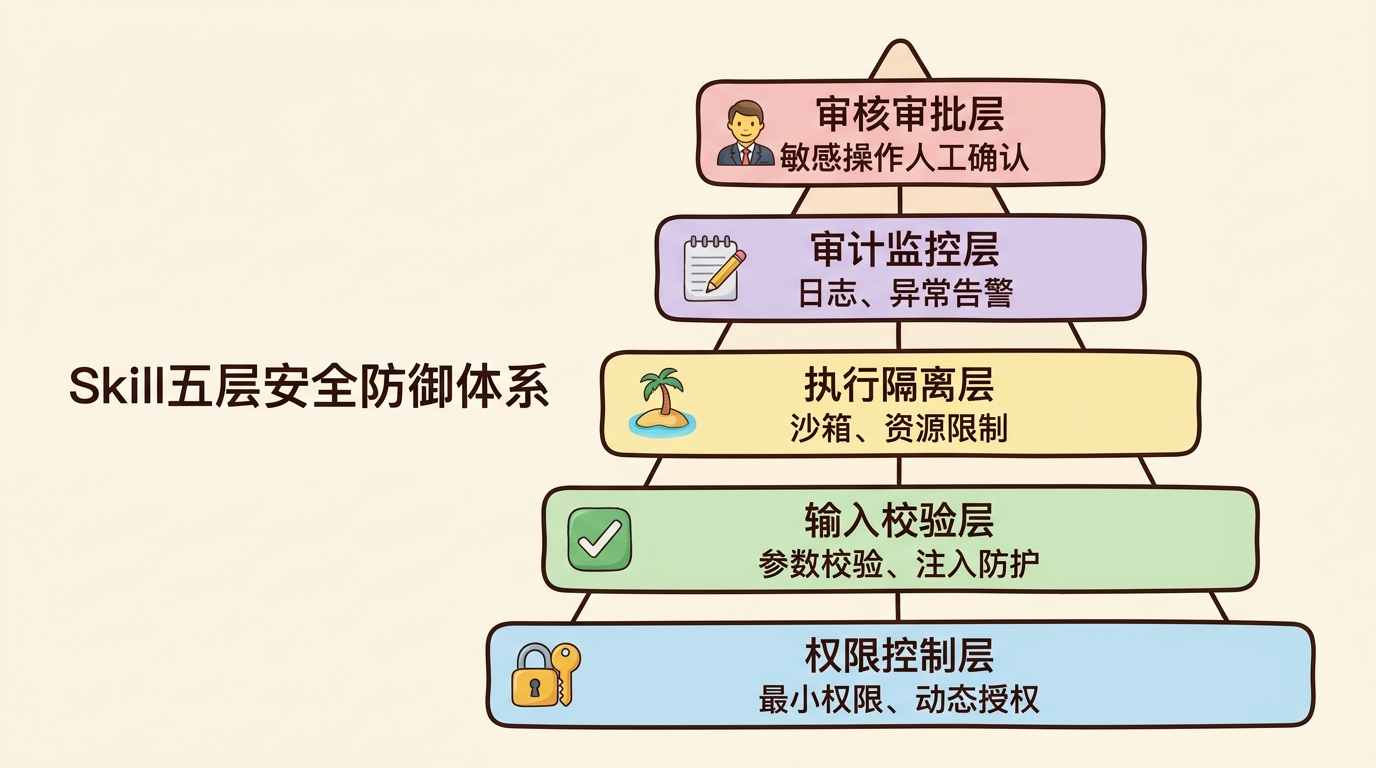
Skill五层安全防御体系
3. 性能优化策略 1
2
3
4
5
6
7
8
9
10
11
12
13
14
15
16
17
18
19
20
21
22
23
24
25
26
27
28
29
30
31
32
33
34
35
36
37
38
39
40
41
42
43
44
45
46
47
48
49
50
51
52
53
54
55
56
57
58
59
60
61
62
63
64
65
66
67
68
69
70
71
72
73
74
75
76
77
78
79
80
81
82
83
84
85
86
87
88
89
90
91
92
93
94
95
96
97
98
99
100
101
102
103
104
105
106
107
108
109
110
111
112
113
114
115
116
117
118
119
from functools import lru_cache
from diskcache import Cache
from concurrent.futures import ThreadPoolExecutor , as_completed
from typing import Generator , Any
# 配置缓存
cache = Cache ( "./.skill_cache" )
# 1. 多层缓存
def cached_skill ( ttl : int = 3600 , use_disk : bool = True ):
"""
缓存装饰器 - 支持内存+磁盘两层缓存
"""
def decorator ( func ):
# 内存缓存(LRU)
memory_cached = lru_cache ( maxsize = 128 )( func )
@wraps ( func )
def wrapper ( * args , ** kwargs ):
# 生成缓存键
key = f " { func . __name__ } : { hash ( str ( args ) + str ( sorted ( kwargs . items ()))) } "
# 尝试内存缓存
try :
return memory_cached ( * args , ** kwargs )
except TypeError :
pass # 不可哈希参数
# 尝试磁盘缓存
if use_disk and key in cache :
return cache [ key ]
# 执行
result = func ( * args , ** kwargs )
# 保存缓存
if use_disk :
cache . set ( key , result , expire = ttl )
return result
return wrapper
return decorator
# 2. 并行化
class ParallelSkillExecutor :
def __init__ ( self , max_workers : int = 8 ):
self . executor = ThreadPoolExecutor ( max_workers = max_workers )
def run ( self , tasks : List [ Dict ]) -> Dict [ str , Any ]:
"""
并行执行多个技能调用
tasks格式:
[
{"name": "task1", "skill": skill1, "params": {...}},
{"name": "task2", "skill": skill2, "params": {...}}
]
"""
futures = {}
for task in tasks :
future = self . executor . submit (
task [ 'skill' ] . execute ,
** task . get ( 'params' , {})
)
futures [ future ] = task [ 'name' ]
results = {}
for future in as_completed ( futures ):
name = futures [ future ]
try :
results [ name ] = future . result ()
except Exception as e :
logger . error ( f "Task { name } failed: { e } " )
results [ name ] = e
return results
# 3. 流式输出
@skill ( streaming = True )
def generate_report_stream ( topic : str ) -> Generator [ str , None , None ]:
"""
流式输出技能 - 适用于生成式任务
用户体验更好,首字延迟更低
"""
for chunk in llm . generate_stream (
f "Write a report about { topic } " ,
stream = True
):
yield chunk . content # 逐个token返回
# 4. 懒加载
class LazySkill :
"""
懒加载技能 - 延迟初始化重型依赖
"""
def __init__ ( self ):
self . _model = None
self . _tokenizer = None
self . _embedding_model = None
@property
def model ( self ):
if self . _model is None :
logger . info ( "Loading ML model (this may take a while)..." )
self . _model = load_heavy_model_from_disk () # 首次使用时才加载
return self . _model
@property
def tokenizer ( self ):
if self . _tokenizer is None :
self . _tokenizer = load_tokenizer ()
return self . _tokenizer
def execute ( self , text : str ) -> Any :
# 使用时才真正加载模型
tokens = self . tokenizer . encode ( text )
return self . model . infer ( tokens )
Skill与MCP的关系 【LLM技术】MCP是什么?宗述和概念梳理
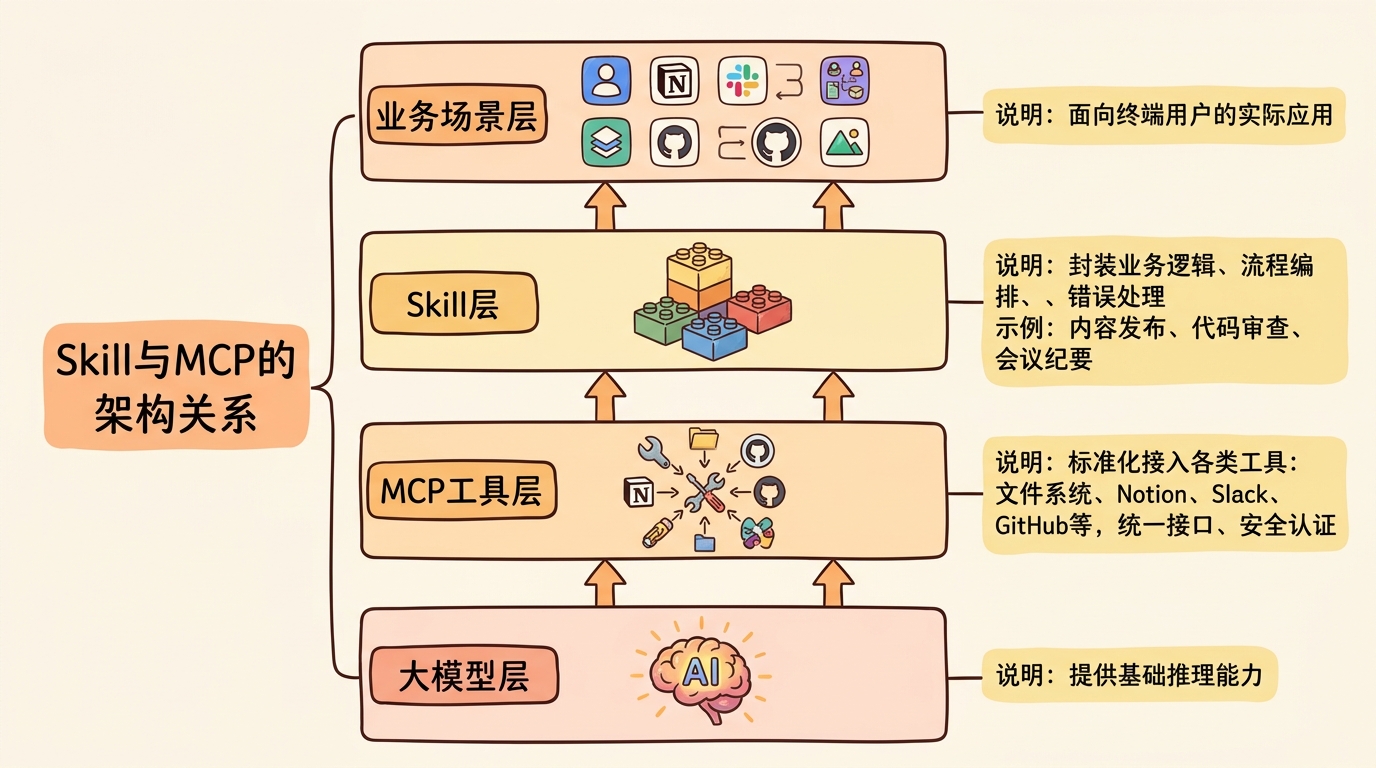
Skill 和MCP (Model Context Protocol) 是互补而非竞争的关系,它们在AI Agent架构中处于不同层级:
Skill 关注的是能力的封装与复用 ,是Agent的"能力库"MCP 关注的是工具的标准化连接 ,是Agent的"插接件"Skill与MCP的完整架构关系
层级 关注点 职责 示例 Skill 能力封装复用 业务逻辑、流程编排、错误处理 内容发布、代码审查、会议纪要 MCP 工具标准连接 统一接口、安全认证、资源管理 文件系统、Notion、Slack、GitHub
两者可以完美配合:
 1
 2
 3
 4
 5
 6
 7
 8
 9
10
11
12
13
14
15
16
17
18
19
20
21
22
23
24
25
26
27
28
29
30
31
32
# MCP提供标准化的工具接入
mcp_client = MCPClient ()
await mcp_client . connect ( "filesystem" )
await mcp_client . connect ( "notion" )
await mcp_client . connect ( "slack" )
# Skill封装业务逻辑,内部使用MCP工具
@skill
def publish_content ( content : str , title : str ):
"""发布内容到多个平台"""
# 使用MCP工具
fs_tool = mcp_client . get_tool ( "filesystem" , "write_file" )
notion_tool = mcp_client . get_tool ( "notion" , "create_page" )
slack_tool = mcp_client . get_tool ( "slack" , "send_message" )
# 业务逻辑
path = fs_tool . call ( path = f "/tmp/ { slugify ( title ) } .md" , content = content )
page = notion_tool . call (
parent = { "database_id" : NOTION_DB },
properties = { "Title" : { "title" : [{ "text" : { "content" : title }}]}},
children = markdown_to_notion_blocks ( content )
)
slack_tool . call (
channel = "#content" ,
text = f "📝 新内容已发布: { page [ 'url' ] } "
)
return {
"file" : path ,
"notion" : page ,
"slack" : "sent"
}
总结 Skill是Agent开发从"玩具Demo"走向"生产可用"的关键一步。通过将复杂能力模块化、标准化、可复用化,Skill让我们能够:
管理复杂度 :将大问题拆解为小问题(借鉴了Dijkstra的结构化编程思想)提升质量 :每个Skill可独立测试和优化(参考了单元测试最佳实践)加速开发 :复用已验证的能力(类比软件库的价值)团队协作 :不同人可以开发不同的Skill(类似微服务架构的团队组织)核心要点回顾 概念 关键要点 渐进式披露 只向LLM暴露当前任务所需的最小能力集,降低决策复杂度、减少Token消耗、提高安全性 技能类型 原子技能(细粒度)→ 组合技能(业务级)→ 元技能(管理级) 执行范式 声明式(灵活)、命令式(可控)、状态机(交互式) 发现机制 语义搜索 + 分类索引 + 懒加载 与MCP关系 Skill封装能力,MCP连接工具,两者互补
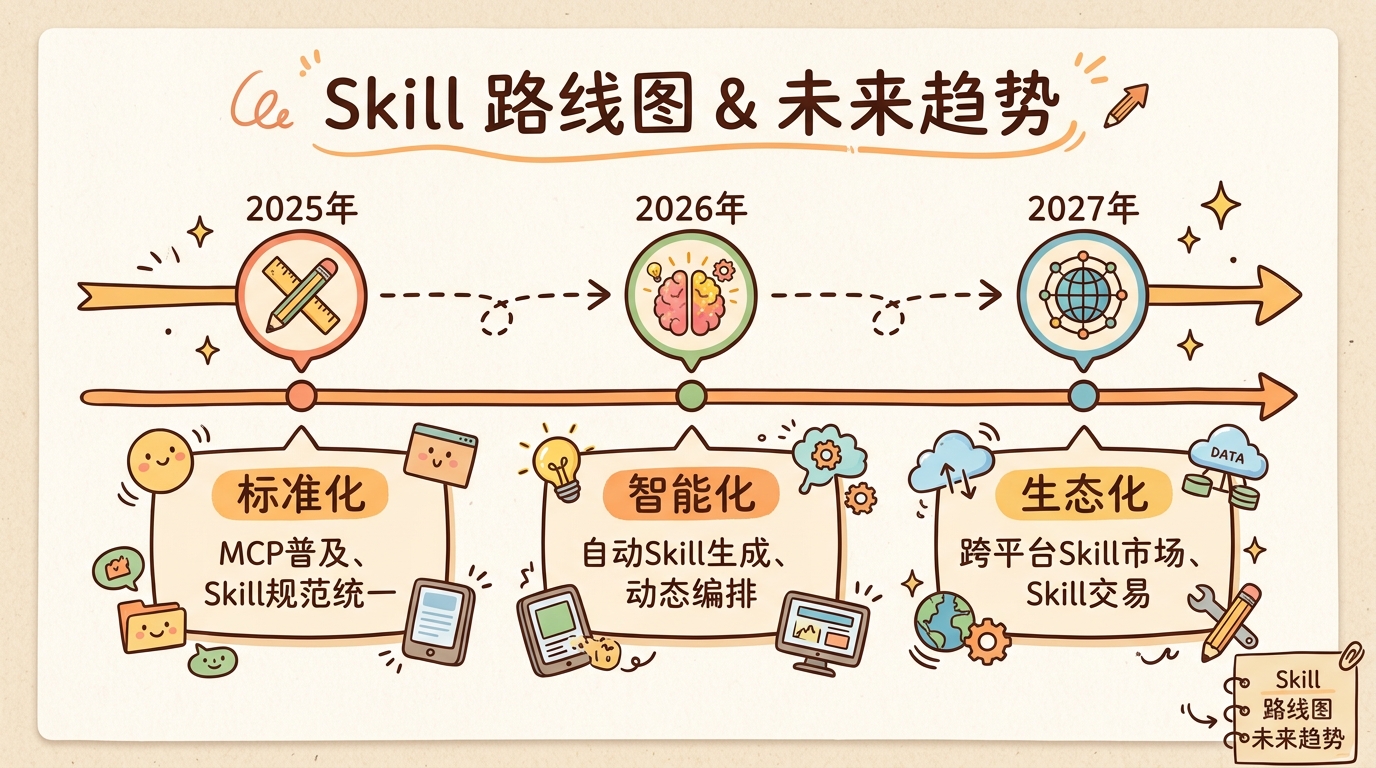
2025-2027 Skill技术发展路线图
Skill不是银弹,但它是构建复杂Agent系统的基石。正如软件工程从"面条代码"进化到"模块化架构",Agent开发也在经历从"单Prompt编程"到"Skill组合"的进化。掌握Skill的设计与应用,特别是渐进式披露 这一核心原则,是成为Agent架构师的必修课。
延伸阅读推荐